

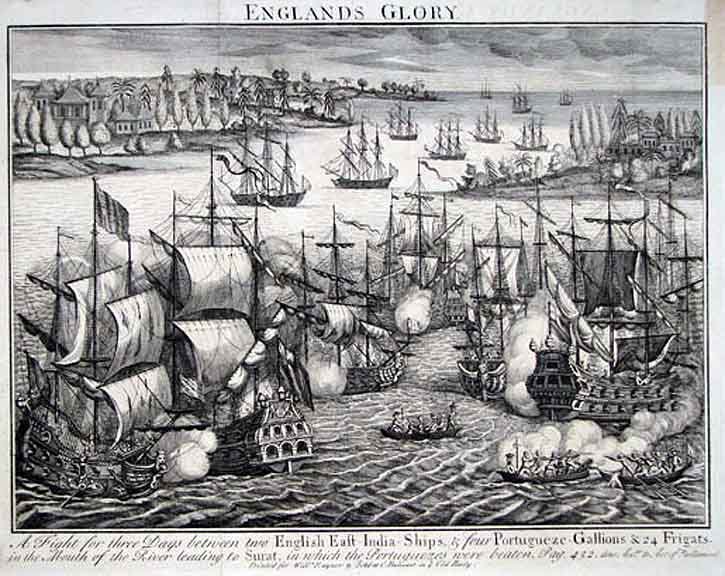
In late 1612, off the Gujarat coast near Surat, two English ships fought a Portuguese fleet in the roads of Swally. Militarily the clash was modest. Its significance lies in how it was seen and reported. Watched from the shore by Mughal officials, merchants and townspeople, it became an unplanned public demonstration of English naval capability at a time when the East India Company was struggling to be taken seriously in Mughal India. Viewed through the modern lens of strategic communication, a concept the historical actors did not use, the battle shows how reputation, observation and the circulation of information shaped the early English challenge to Portuguese influence.
Portuguese Authority and English Weakness
By 1612, the Estado da Índia had dominated the Indian Ocean for a century. Its authority rested less on permanent garrisons than on control of the sea lanes and on the cartaz, a pass that Asian shipping was expected to purchase and carry. Ships without one risked seizure. The system was a political claim as much as a commercial instrument, and every vessel carrying a cartaz acknowledged Portuguese pretensions. Gujarati merchants, including those sending ships to the Red Sea, were habituated to it.[1]
The English Company, by contrast, had little standing. William Hawkins reached Surat in 1608 and spent time at Jahangir’s court, but Portuguese opposition, and the Jesuits’ established presence there, frustrated his efforts to secure lasting privileges. Sir Henry Middleton’s visit in 1611 fared little better, and local officials, wary of Portuguese retaliation against Gujarati shipping, did not welcome the English. João Vicente Melo’s study of Jesuit and English experiences at the Mughal court shows that both groups competed for imperial favour through gifts, presentation and the management of their image, and that the Jesuits had a considerable advantage at this stage.[2]
The Engagement at Swally
Captain Thomas Best arrived in 1612 with the Dragon and the Hosiander. According to his journal, edited by William Foster, the Portuguese fleet, commonly reckoned at four galleons and a number of smaller craft, attacked in the shallows off Swally. The English ships, using superior gunnery and manoeuvre, repelled repeated attacks over several days, including attempts to use fire against them. Best’s account naturally emphasises English skill and Portuguese misjudgement, and the numbers and details are best treated as one participant’s version.[3]
What matters here is the setting. Swally lay close to Surat and the engagement could be seen from the shore. Foster’s edition and Nicholas Withington’s narrative both indicate that local observers were present, though neither allows us to measure how many or what each concluded. A fight in open view carried a different weight from a distant naval action. Portuguese prestige had long depended on the assumption that their sea power was effectively unchallengeable. Seeing that assumption tested, and Portuguese vessels forced to withdraw, offered a concrete reference point that rumour alone could not.
Reputation and the Flow of News
News of the outcome spread through the port, among merchants, and up the chain of Mughal officials. Withington records that Sardar Khan, a Mughal commander present in the area, reported the result to Emperor Jahangir. The existence of such a report is reasonably documented. Its precise wording and its influence on the emperor’s thinking are not, and historians should be cautious about assigning it decisive effect.[4]
The two sides read the defeat differently. The English presented it as proof that a small, well-handled force could defeat Portuguese ships, a useful argument for a company seeking credibility. The Portuguese tended to treat Swally as a local setback rather than a collapse of their position, and they retained the resources of Goa, Diu and Daman. Both interpretations reflect interests as much as facts.[5]
The Mughal Perspective
It would be a mistake to treat the Mughals as passive spectators. Mughal officials were assessing the balance of power for their own purposes. Gujarat’s trade, the safety of pilgrim and merchant shipping, and revenue were all affected by Portuguese control of the sea. Surat’s governor and the court had practical reasons to explore a second European partner who might counterweigh Portuguese pressure, while also remaining cautious about provoking a power capable of harassing Mughal ships. Melo’s work supports this picture of a court weighing rival European claims rather than being swayed by a single event.[6]
Converting Reputation into Opportunity
Best sought to turn his success into commercial footing. He negotiated with local officials and left factors at Surat when he sailed in early 1613, an outcome that would have been harder to obtain before the battle. Yet the effects were gradual. Portuguese influence persisted. In 1613 the Portuguese seizure of a Mughal vessel provoked a serious dispute, which showed both the continuing reach of their naval power and Mughal readiness to respond. Thomas Roe’s embassy from 1615 was still needed to negotiate English privileges, and the Company’s position was only consolidated over the following decades, including through later naval successes in the region.[7]
Conclusion
Swally did not end Portuguese dominance, nor did it alone secure English trading rights. Its importance lies in how an observed and widely reported engagement altered perceptions: it gave the English a credible claim to naval competence, gave Mughal decision-makers fresh information with which to weigh their options, and gave the Portuguese a challenge to interpret and answer. The episode is best understood as a step in a longer process in which military events, public visibility and the movement of news together shaped who was regarded as a serious power on India’s western coast.
Notes
[1] Luís Filipe Reis Thomaz, “The Portuguese Control over the Indian Ocean and the Cartaz System,” in Os Mares do Oriente: A Presença Portuguesa circa 1507: Actas do X Simpósio de História Marítima (Lisbon: Academia de Marinha, 2011), 267–68, 327–33.
[2] João Vicente Melo, Jesuit and English Experiences at the Mughal Court, c. 1580–1615 (Cham: Palgrave Macmillan, 2022), 185–88.
[3] Thomas Best, The Voyage of Thomas Best to the East Indies, 1612–1614, ed. William Foster (London: Hakluyt Society, 1934); Nicholas Withington, “Nicholas Withington, 1612–1616,” in Early Travels in India, 1583–1619, ed. William Foster (Oxford: Oxford University Press, 1921), 188–90; Melo, Jesuit and English Experiences, 189–90.
[4] Withington, “Nicholas Withington,” 199; Melo, Jesuit and English Experiences, 190–91.
[5] Melo, Jesuit and English Experiences, 190; Thomaz, “Portuguese Control,” 327–33
[6] Melo, Jesuit and English Experiences, 190–91; Edmond Smith, “Naval Violence and Trading Privileges in Early Seventeenth-Century Asia,” International Journal of Maritime History 25, no. 2 (2013): 147–58, especially 154.
[7] Withington, “Nicholas Withington,” 193–94, 203; Melo, Jesuit and English Experiences, 191–232.