

Introduction
On a map, the Andaman and Nicobar Islands look like a chain of outposts strung across the Bay of Bengal towards the Strait of Malacca. Their history is more complicated. For thousands of years, they have been home to communities with their own languages, territories and political worlds, the Great Andamanese, Jarawa, Onge and Sentinelese in the Andamans, and the Nicobarese and Shompen in the Nicobars. Outside powers did not arrive in an empty space, even when their records described it that way.[1]
The islands also changed meaning under each power that ruled them. For the British they were a prison and an outpost, for the Japanese a captured naval position, and for independent India a frontier of national identity and maritime presence. This article follows those changes through the buildings, ceremonies, networks and institutions each power used to present its authority.
British Rule: Control Through Isolation
British interest in the Andamans began in the late eighteenth century. A settlement at Port Blair in 1789 was abandoned in 1796. Permanent colonisation followed the revolt of 1857, when the British were looking for a place to confine large numbers of rebels and convicts. Aparna Vaidik’s Imperial Andamans shows how the colony became a place where the British tested ideas of order, labour and reform, while Clare Anderson’s work places it within wider convict movements across the Indian Ocean.[2]
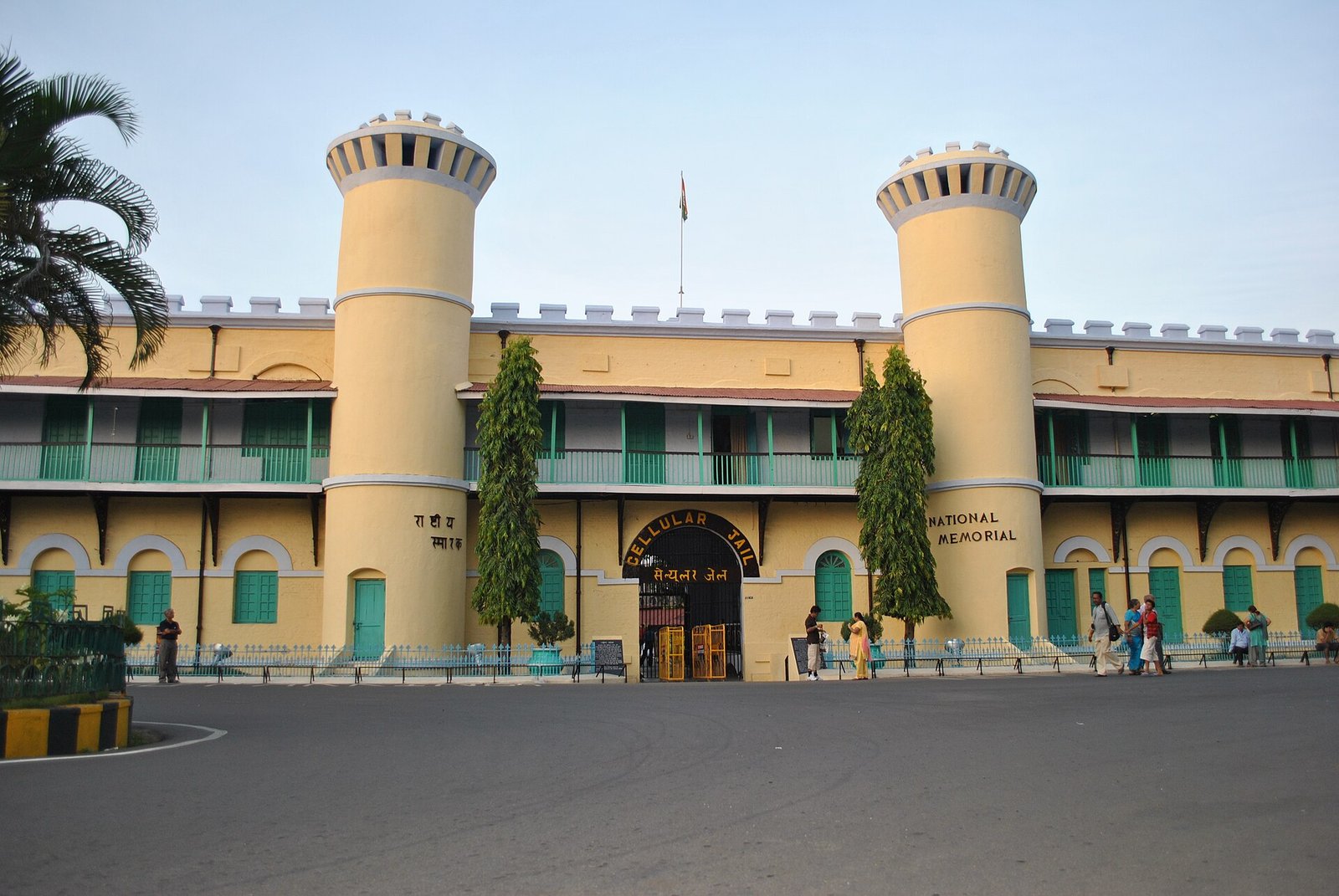
The place itself carried a meaning. Transportation across the “kala pani” removed convicts from their families, castes and communities. This made the islands a warning to the mainland as well as a prison. The Cellular Jail, built between 1896 and 1906, gave that warning a physical form. Its design, with single cells and a central watchtower, expressed an ideal of constant observation. Satadru Sen’s work on convict society shows that daily life was shaped by discipline, hierarchy and the colonial state’s anxiety about the prisoners it held.[3]
Communication infrastructure expressed the same authority. Medha Saxena’s 2025 article shows that the wish to stay connected to the mainland and the need to keep prisoners isolated made the islands a testing ground for secure communication, with censorship as crucial as connection. Access was limited so that the technology could not serve convicts, and the article also shows that it exposed inconsistencies in how the colonial state worked. Control and anxiety coexisted.[4]
The Andamans and Nicobars had different colonial histories. The Nicobars had Danish and missionary connections before Britain took over in 1869, and they were never a convict settlement on the Port Blair model. In the Andamans, the colonial state treated Indigenous peoples as subjects of study and “protection”. New Histories of the Andaman Islands, edited by Clare Anderson, Madhumita Mazumdar and Vishvajit Pandya, shows how colonial photography, ethnography and policy made Andamanese people into objects of administration. Contact, disease and displacement sharply reduced the Great Andamanese population. The colonial claim of benevolent authority sat alongside a history of damage.[5]
The Japanese Occupation: A Claim of Sovereignty
Japan took Port Blair in March 1942 and occupied both island groups until 1945. Real power stayed with the Japanese military throughout. Local people suffered under suspicion of espionage, harsh punishment and wartime shortages, which a purely symbolic account of this period can hide.[6]
The most famous event of the occupation was Subhas Chandra Bose’s visit. He landed on 29 December 1943, hoisted the tricolour on 30 December, named the Andamans “Shaheed” and the Nicobars “Swaraj”, and appointed A. D. Loganathan as governor. Bose also visited the Cellular Jail, a place the British had used to demonstrate imperial power. By raising an Indian flag in the colony the British had built, the visit declared that Indian authority now existed on Indian soil.[7]
This was most clearly a message to Indians in Southeast Asia, whose support the Azad Hind movement depended on. T. R. Sareen’s work on Japan and the Indian National Army helps explain the wartime partnership that made the ceremony possible. It is, however, an interpretation that the ceremony was designed with these audiences in mind. What the documents firmly establish is the event itself, the renaming and the appointment.[8]
The limits of the claim are equally documented. According to accounts drawn from his post-war statements, Loganathan had full control only over the education department, while the Japanese kept the police. The flag-raising was a declaration of sovereignty, not an exercise of it. Even so, the symbol endured. The memory of 1943 shaped later national commemoration, including the 2018 renaming of Ross, Neil and Havelock Islands after Bose, “Shaheed” and “Swaraj”.[9]
Independent India: From Penal Colony to Frontier
After 1947 the islands were integrated into the Indian Union, and their meaning changed again. Uditi Sen’s research on refugee resettlement shows that settling displaced families from East Bengal made the islands part of India’s project of citizenship and nation-building. This brought new pressures on Indigenous peoples, affecting the Andamanese, Nicobarese and Shompen in different ways. The Cellular Jail, once a symbol of imperial punishment, became a national memorial in 1979. The building stayed the same, but what it stood for was reversed.[10]
The most deliberate statement of Indian presence came in 2001. After the Kargil Review Committee’s recommendations, the Group of Ministers approved an integrated command in May 2001, and the Andaman and Nicobar Command began at Port Blair on 8 October under Vice Admiral Arun Prakash. It remains India’s first tri-service geographic command, led by an officer drawn from the three Services by rotation. Strategic analysts, including Gurpreet S. Khurana, have discussed it as an experiment in military jointness and as a means of making India’s presence in the eastern Indian Ocean continuous and visible.[11]
What this presence communicates depends on the audience. To Southeast Asian neighbours, coordinated patrols and disaster-relief work suggest a cooperative regional partner. To other powers active in the Indian Ocean, a standing command near the Malacca approaches signals permanence. To Indians, the islands are no longer a remote penal frontier but a visible part of national identity, a theme reflected in the 2024 renaming of Port Blair as Sri Vijaya Puram. These readings are interpretations drawn from official statements and analysts’ work, not a declared doctrine.[12]
Credibility matters, though. The command’s 25th anniversary in October 2026 has prompted public discussion of its future, and development proposals in Great Nicobar have drawn debate about Indigenous rights and ecology. How India treats the islands’ people and environment is itself part of what its presence says.[13]
Conclusion
In under two centuries the islands were used to state three different kinds of authority. The British used a prison and a controlled communication network to show power while revealing their own anxieties. The Japanese-era ceremony of 1943 asserted Indian sovereignty, but real control remained with Japan. Independent India has turned the islands from a place of confinement into a place of national memory and maritime presence.
In each period, the islands’ meaning came from the powers that used them and from the people already living there. For India today, the islands’ strategic value cannot be separated from how convincingly the state shows that its presence is lawful, lasting and respectful of the communities who live there.
Notes
[1] Andaman and Nicobar Administration, “People and Culture,” District South Andaman, Government of India, https://southandaman.nic.in/people_culture/; Directorate of Health Services, Andaman and Nicobar Administration, “Tribal Health,” https://dhs.andamannicobar.gov.in/TribalHealth.
[2] Aparna Vaidik, Imperial Andamans: Colonial Encounter and Island History (Basingstoke: Palgrave Macmillan, 2010); Clare Anderson, “Colonization, Kidnap and Confinement in the Andamans Penal Colony, 1771–1864,” Journal of Historical Geography 37, no. 1 (2011): 68–81.
[3] Satadru Sen, Disciplining Punishment: Colonialism and Convict Society in the Andaman Islands (New Delhi: Oxford University Press, 2000); UNESCO World Heritage Centre, “Cellular Jail, Andaman Islands,” Tentative Lists, https://whc.unesco.org/en/tentativelists/5888/.
[4] Medha Saxena, “Island Networks: Telecommunications in the Andaman and Nicobar Islands in the Early Twentieth Century,” The Indian Economic & Social History Review 62, no. 2 (2025): 189–221.
[5] Andaman and Nicobar Administration, “About District,” District Nicobar, Government of India, https://nicobars.andaman.nic.in/about-district/; Clare Anderson, Madhumita Mazumdar, and Vishvajit Pandya, eds., New Histories of the Andaman Islands: Landscape, Place and Identity in the Bay of Bengal, 1790–2012 (Cambridge: Cambridge University Press, 2016).
[6] Directorate of Art and Culture, Andaman and Nicobar Administration, “About Art and Culture,” https://artculture.andamannicobar.gov.in/aboutart; T. R. Sareen, Japanese Occupation of the Andaman and Nicobar Islands, 1942–1945: Reports and Documents (New Delhi: Life Span Publishers and Distributors, 2014).
[7] Sareen, Japanese Occupation of the Andaman and Nicobar Islands; Directorate of Art and Culture, Andaman and Nicobar Administration, “About Art and Culture.”
[8] Sareen, Japanese Occupation of the Andaman and Nicobar Islands.
[9] Sareen, Japanese Occupation of the Andaman and Nicobar Islands; Press Information Bureau, Government of India, “PM Visits Andamans,” December 30, 2018, https://www.pib.gov.in/PressReleaseIframePage.aspx?PRID=1557808.
[10] Uditi Sen, “Memories of Partition’s ‘Forgotten Episode’: Refugee Resettlement in the Andaman Islands,” Südasien-Chronik – South Asia Chronicle 7 (2017): 147–78.
[11] Pramod Sangwan, “Andaman and Nicobar Command: From an Experiment to a Model,” Journal of Defence Studies 5, no. 4 (2011); Gurpreet S. Khurana, “Shaping Security in India’s Maritime East: Role of Andaman & Nicobar,” Strategic Analysis 30, no. 1 (2006): 161–81.
[12] Khurana, “Shaping Security in India’s Maritime East”; Press Information Bureau, Ministry of Home Affairs, “Government Has Decided to Rename the Capital of Andaman & Nicobar Islands Port Blair as ‘Sri Vijaya Puram’,” September 13, 2024.
[13] Press Information Bureau, Ministry of Defence, “Message by CDS on the 21st Raising Day of Andaman & Nicobar Command”; Ministry of Environment, Forest and Climate Change, Government of India, “Impact of Great Nicobar Project,” Rajya Sabha Unstarred Question No. 1968, December 12, 2024; Nikhil Ghanekar, “Nicobar Project: Minister Says Concerns Addressed, MP Says Release Reports,” The Indian Express, June 19, 2026.