

Introduction
This article deals with the question that, how did the Chola rulers employ the temple as an instrument of conveying political power, authority and legitimacy? It explores the case of the Brihadisvara Temple at Thanjavur built by Rajaraja I (985-1014 CE) in the terms of the analysis Model of Strategic Communication: Monuments. The central idea revolves around Brihadisvara Temple, was not only a sacred structure. It also revealed the existence of royal power, associated kingship with religious legitimacy, recorded political achievements and conveyed the image of the eternity of the Chola power.
The Monument: Scale, Name and Royal Character
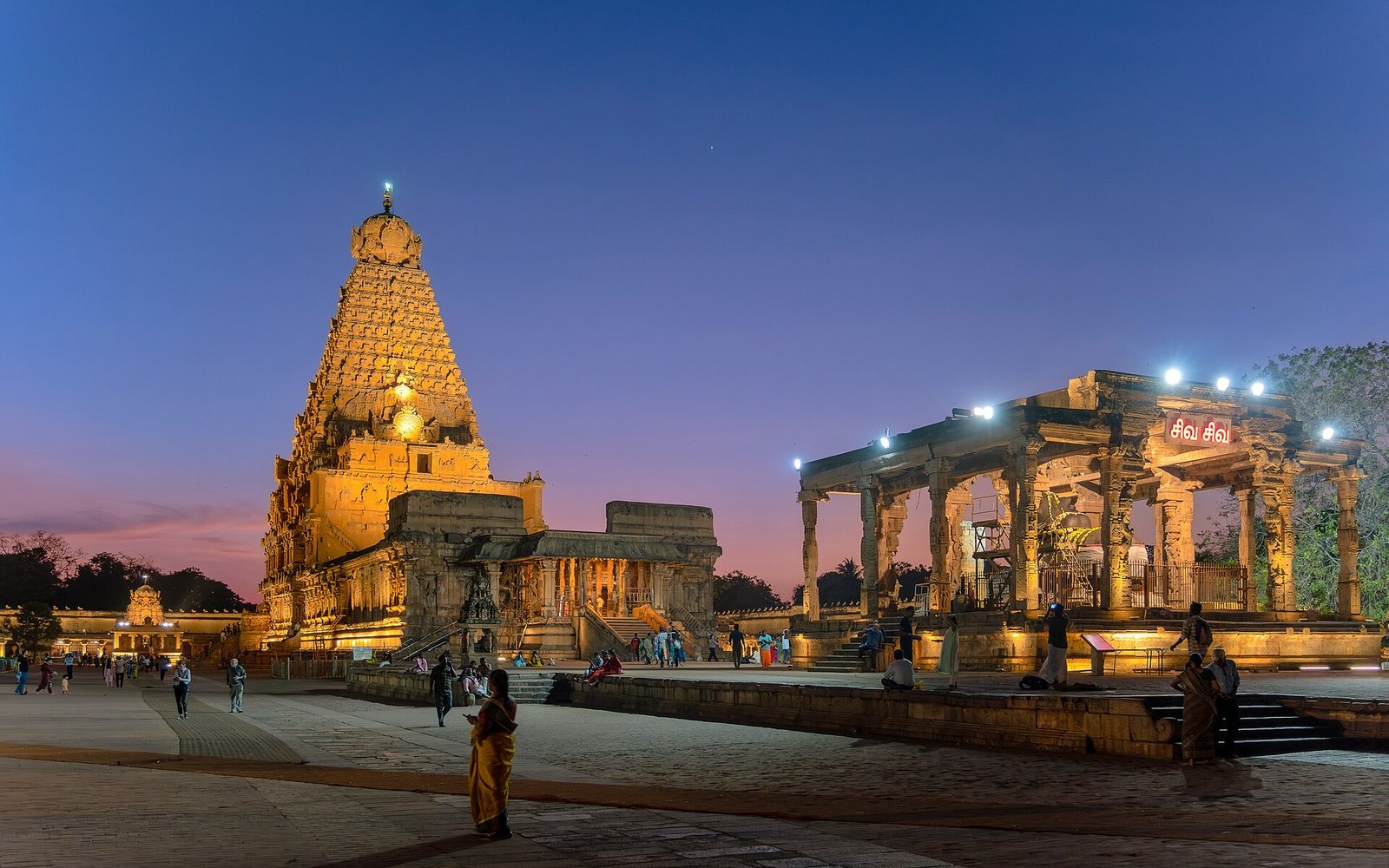
According to the inscriptions, Rajaraja built the temple and gave it the name after himself -Rajarajesvara (“Isvara of Rajaraja”).[i] Branfoot suggests that Rajaraja’s name in the god’s title (“Lord of Rajaraja”) reflects the intimacy of the relationship between the god and the king, and that Shiva was also called the Lord of the Southern World-Mountain since Rajaraja offered him a new residence in the south. He notes that previously constructed temples in the Kaveri Valley were not higher than about ten meters, while the tower in the Thanjavur Temple reaches almost sixty. Branfoot also remarks that Thanjavur turned into an important political center only with the construction of this temple and the royal center surrounding it.
From the interpretive viewpoint, the construction several times higher than any other nearby, bearing the name of the king and containing a deity called the “Lord of Rajaraja” made royal power and identity visible in the capital. The fact that each component was intended to have such an effect cannot be proved based on the available information. Only the name and the scale are recorded in the sources; no reasons why the king constructed the temple in such a manner are stated.
Inscriptions as a Public Record of Kingship
Many things are recorded in the inscriptions. SII II, No. 1 begins with a Sanskrit verse about the edict of Rajaraja which was followed by all princes and continues in Tamil; a list of conquests is placed in the beginning of most of his records. The inscriptions include the description of the gifts of gold presented by the king on some dates, including gold trumpets after he adopted the titles Sivapadasekhara (devotee of Siva) and Rajaraja (king of kings) and gold flowers after his conquest of Satyasraya. Another inscription says that the images erected by the king were compared with a cubit measure kept in the temple and engraved on stone.[ii]
Contextualizing historians include Branfoot who observes that the inscriptions proclaim conquests of the kings of Kerala, the Pandyas of Madurai and in Sri Lanka, but the bulk of information is devoted to the founding of the temple and subsequent donations, and that the temple employed more than 800 people, of which there were 400 dancers, and 369 villages related to the temple as endowments.[iii] Dehejia adds that the inscription of Rajaraja gives names of the individual villages within his realm and quantity of ingredients that each had to provide as offering for numerous bronze images in Thanjavur. Her main point is that walls of the temple served as a public records office: records were kept in palm leaf, but inscribing on stones provided a highly reliable method for the public record keeping that could be consulted in disputes about the gifts. She also observes that no dynasty in India decorated walls of its temple in such a way.[iv]
This is how the strategic communication approach works. In one of walls, the record unites royal identity (name and titles), achievement (conquest), gift (donations) and place (the temple). Gifts could be dated to such events as a new title or a victory to bring political history into the ledger of the temple. Naming villages connected royal authority over his territory to ritual of the temple. As the walls are explained by Dehejia as a record keeping medium, this article does not suggest that walls were intended to be used as a royal display. Walls of the temple became the durable public record of kingship due to their usage by the state and the temple.[v]
Who Could Read, Who Could See
Dehejia’s analysis of the Nageshvara temple in Kumbakonam brings her to the conclusion that inscriptions in the temple are the archives, that it is unlikely that the visitors could read them, and that they were read only by donors, priests and arbiters of the disputes. It is also suggested that the inscriptions played the decorative role as well. Dehejia warns that it cannot be assumed that gifts in Chola temples were royal: in the temple of Tiruvenkadu, the bronze dating to 1011 was established by a military leader of an elite regiment named after the emperor Rajaraja Jananatha.[vi]
There are three audiences. The readers of the text were officials, donors and priests, and records of their gifts were connecting them with the throne. Public audience received the message via scale, tower and temple festivals, but not via reading; dense script may serve as the symbol of the authority for those who could not read it, but this is an inference. Rulers and the visitors from elsewhere saw the monument that indicated resources and organization, although there is no source evidence about their impressions.[vii]
The Political Effect
From this evidence several effects could be traced, although all of them are the inferences. Royal name, title Sivapadasekhara alongside the gifts, and god’s name united the royal legitimacy with the religious one. Dehejia observed that in another case two priests were found guilty of the crime against both God (Shivadroha) and the king (rajadroha), and this is the evidence that two of them were combined in practice.[viii] Edict, the villages named in offering records and regiment bearing Rajaraja’s name indicate the political authority over the officials and territory.
Military accomplishment is depicted in the conquest lists and also the gifts made following the Satyasraya campaign. Another observation made by Dehejia is that a 1026 inscription at Punjai, under the rule of Rajendra, states that there was an annual festival of Shiva along with the bull in order to guarantee the victory of the king.[ix]
Royal dynastic power can be traced from the fact that one inscription at Brihadisvara talks about the offerings of the temple manager from Rajaraja’s reign up to the third year of Rajendra I.[x] According to Branfoot, Rajendra later built another royal temple called Gangaikondacholapuram with Shiva named as Rajendracholishvara. The permanence in the inscription is also evident by means of the fact that stone was used, as well as by further use: a record of Rajaraja III’s third year depicts a pact between three chiefs, inscribed in the temple, to always be loyal to the king. Branfoot states that the temple continued being a religious institution even after the fall of the Cholas.[xi]
Conclusion
Brihadisvara temple was also a medium of communicating with the people. By size and name, the king’s power was visible; by the inscriptions, identity, conquest and gifts were recorded permanently and by later usage, the permanency of the temple can be seen. The surviving evidence does not usually explain why the medium was used in this way; hence, the messages and effects are interpretations based on scholarly analysis of Dehejia, for example.
Notes
[i] Eugen Hultzsch, ed. and trans., South Indian Inscriptions: Tamil Inscriptions of Rajaraja, Rajendra-Chola, and Others in the Rajarajesvara Temple at Tanjavur, vol. 2, pt. 1 (Madras: Government Press, 1891), inscription no. 1.
[ii] Hultzsch, South Indian Inscriptions, vol. 2, pt. 1, inscription no. 1, relevant passages on the king's titles, gifts and measurements.
[iii] Crispin Branfoot, “The Chola Temples,” Sahapedia, section “The Great Chola Temples: Thanjavur, Gangaikondacholapuram and Darasuram,”
[iv] Vidya Dehejia, “Chola Inscriptions—An Introduction,” 32–37.
[v] Dehejia, “Chola Inscriptions—An Introduction,” 36–37.
[vi] Dehejia, “Chola Inscriptions—An Introduction,” 32–35.
[vii] Dehejia, “Chola Inscriptions—An Introduction,” 32–35.
[viii] Dehejia, “Chola Inscriptions—An Introduction,” 30–31.
[ix] Dehejia, “Chola Inscriptions—An Introduction,” 34–35.
[x] 1. Hultzsch, South Indian Inscriptions, vol. 2, pt. 1.
[xi] Crispin Branfoot, “The Chola Temples,” Sahapedia, section “The Great Chola Temples: Thanjavur, Gangaikondacholapuram and Darasuram,”