

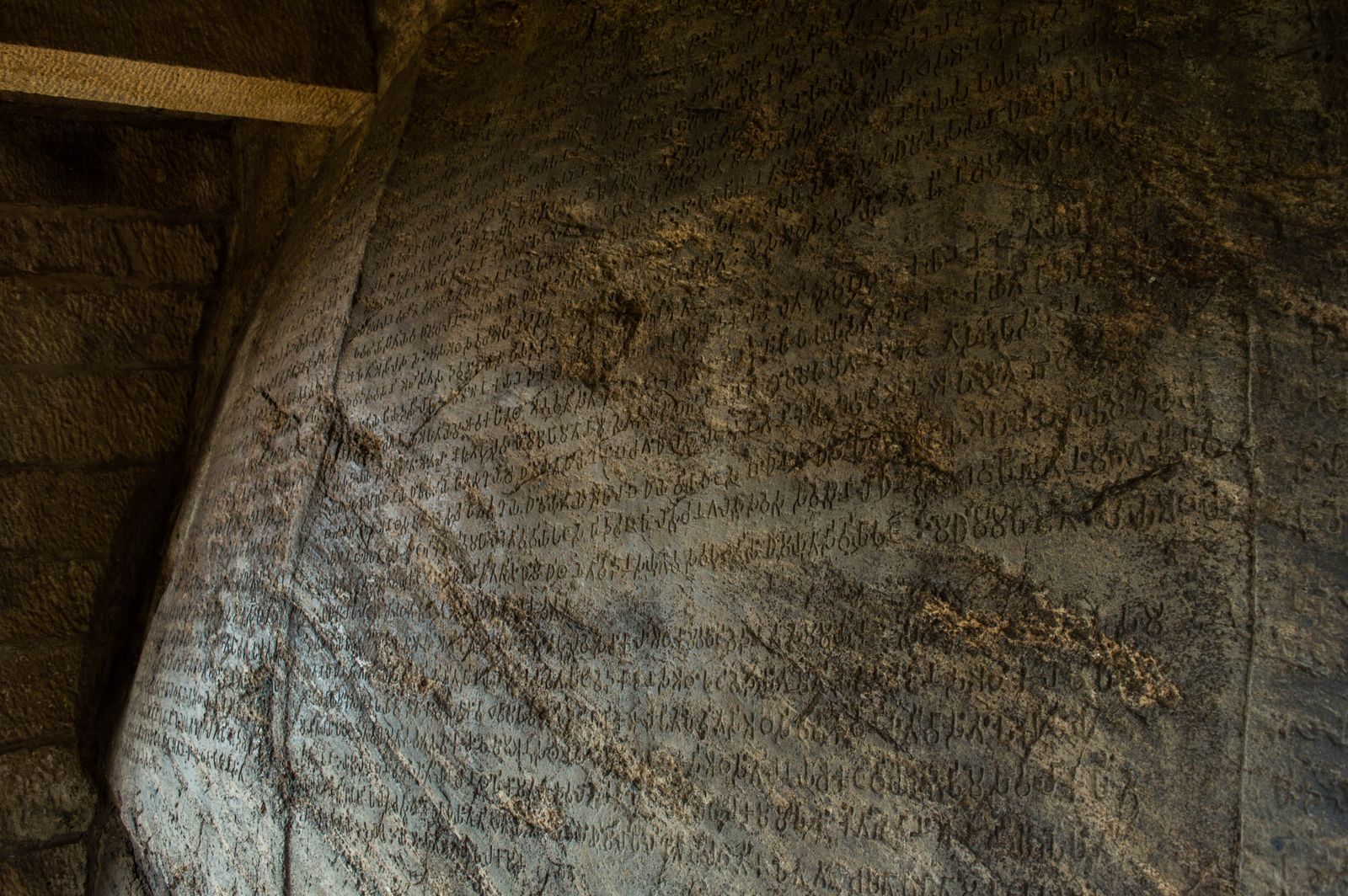
“Ashoka’s edicts deal with his understanding of the nature of social ethics, his effort at persuading his subjects into adopting these ethics and his evaluation of his efforts at introducing a new ethic”[i]
- Romila Thapar
Kalinga and the Emergence of a New Imperial Message
Ashoka says in Rock Edict XIII that his conquest of Kalinga in the eighth year of his reign caused the deportation of 150,000 people, death of 100,000 people and many deaths afterward. He adds that he feels regret for these losses. Then Ashoka declares that conquest through Dhamma will be preferred in future to conquest through force.[iii]
This may be read as a simple history, but when seen as communication, it is a public announcement of a new definition of royal power, after a brutal conquest. Ashoka made use of a lasting and conspicuous medium to announce this message across his empire. The content of the message, the audience, the medium of communication, the adaptation of the message, and the intended effect provide an effective framework for analyzing the inscriptions in the light of modern strategic communication concepts.
This does not mean that the ancient ruler had the modern concept of strategic communication. There is no evidence to this effect. Instead, the modern concepts such as message, audience, medium, dissemination, adaptation, and intended effect can be used as effective tools of analysis in understanding the functions of the inscriptions. Thus, this framework is to be treated only as an analytical tool, not as a reflection of Mauryan thinking.
Dhamma as a Civic Ethic, not a Creed
Ashoka selected the message of Dhamma for communicating to his empire. This needs clarification since it is commonly taken as “Buddhism”. The content of the inscriptions shows that the Mauryan king saw Dhamma as a broad-based ethic and society. These include respect for parents and elders, generosity to ascetics and Brahmins, kindness to servants, restraint in speech and care for all living beings.[iv]
The Historian, Romila Thapar’s interpretation of the meaning of Dhamma as a wide-ranging code of ethics and social conduct that could be applicable regardless of religion also provides another way of understanding Ashoka’s message.[v] In addition, Patrick Olivelle’s study of the political thought of ancient India gives us the possibility of seeing Ashoka’s thoughts about Dhamma as part of a wider political tradition of kingship and governance.[vi]
Therefore, Dhamma was not only a call for conversion to Buddhism. Ashoka used it as a language of conduct which could be understood by diverse religious and social groups.
In addition, Ashoka’s message was not entirely pacifist. On the one hand, in the same Rock Edict XIII that shows his regret about the suffering he caused with the conquest of Kalinga, Ashoka says that forest people who live outside his domains can be punished by him if needed. This means that Ashoka did not give up coercive power. However, it seems that Dhamma helped to redefine the nature of that power and its aims.[vii]
Thus, the king wanted to redefine his authority rather than to renounce his power.
The Medium: Inscriptions as Instruments of Communication
In this regard, it is worth noting that stone inscriptions are the media which were neither fast nor changeable. In this case, their big advantage lies in the fact that once inscribed, the message would stay in the landscape for many years even after the messenger left the office.
The geographic location of the inscriptions of Ashoka is noteworthy. The major Rock Edicts are located at places like Kalsi, Girnar, Dhauli, Jaugada, Shahbazgarhi and Mansehra. There are also inscriptions in some places far removed from the center of power, such as those located in trade centers and frontier zones as well as in newly acquired regions. The Pillar Edicts, on the other hand, were mostly found in the Gangetic and north-central regions.[viii]
But this is not necessarily proof that all the inscriptions were posted according to a pre-conceived plan formulated by Ashoka for the purpose of communication. What can be concluded from the geographic distribution of these inscriptions is that Ashoka’s messages were intended to reach far beyond the immediate surroundings of the court.
This means that the inscriptions of Ashoka became an integral part of the landscape of his empire. As compared to a traveling messenger, stone ensured that the message remained after the messenger himself had left.
One Message, Different Addressees to Audiences
The inscriptions were not meant to reach one homogeneous audience. Some of the inscriptions were meant for specific audiences in particular situations.
For instance, Rock Edict III is an instruction for the Yuktas, Rajukas and Pradesikas to tour the country and propagate Dhamma along with performing their other official functions.[ix] Rock Edict VI is yet another way to examine the ways in which Ashoka communicated. In this edict, the king describes his readiness to listen to the reports on matters of public affairs and welfare. Such a message reveals a different side of the king who is approachable and who is in charge of the well-being of his subjects.[x]
Rock Edict IV draws a comparison between “the sound of war drums” and “the sound of Dhamma”. Here the contrast of the values associated with kingship is communicated and at the same time Ashoka makes a broader statement regarding his rule.[xi]
Pillar Edict VII, issued by Ashoka later on, is yet another example of Ashoka’s communication. This edict is a summary of all the measures associated with Dhamma, such as construction of wells and planting trees and other facilities for people and animals. This inscription may serve as evidence that Dhamma was not only an ethical principle, but also a governmental activity.[xii]
Separate Kalinga Edicts serve as an excellent example of targeted message delivery. These edicts were addressed to the officials in charge of the recently conquered territory and contained instructions regarding the humane treatment of people. The king asked officials to treat people like his children. Thus, it may be said that here Ashoka tried to create a new attitude towards the administration of conquered territories.[xiii]
Adaptation and Intended Influence
From this analysis it may be concluded that the messages delivered by Ashoka via inscriptions varied depending on the audience.
They had been told how they should conduct their rule. They themselves had been provided with guidelines about the way they should behave and act socially. The religions had been advised that they should treat each other with mutual respect. The people of Kalinga had received instructions about the proper behaviour of the officials and the treatment given to the defeated population.[xiv]
This is a good example of strategic audience-oriented communication from the point of view of modern times. The main idea was more or less the same, but its form depended on the audience and the occasion.
One of the most illustrative in this connection is Rock Edict XIV where Ashoka says that the contents of his edicts were different: some were smaller, some bigger and some incomplete. It gives us direct evidence that the imperial message could vary under different circumstances.[xv]
It is very difficult to guess what exactly was meant by the rulers, but it may be inferred from the inscriptions that he tried to create a certain conception of the right way for a king to rule. He should rely not only on the military force of his empire but also on care for the welfare of his subjects, moderation and morality.[xvi] The works of John Strong on the legends connected with Ashoka help us to distinguish the image of Ashoka in the inscriptions of the third century BCE from the great legend of Ashoka which had developed around this king during the following centuries.[xvii]
What the inscriptions cannot tell us is just as important as what they can.
These are the only ways by which we can gather evidence as to what Ashoka communicated, the audiences he targeted, and the means he used to get the message out. These cannot tell us whether the instructions were always followed by the officials, how the common folk interpreted these inscriptions and how far-reaching was the influence of Dhamma on the everyday life of the empire.[xviii]
And this forms the major drawback in viewing the reign of Ashoka in the context of strategic communication. Strategic communication is a helpful way to find out the correlation among message, audience, medium, dissemination and the desired effects, but this should not be misconstrued to mean that Ashoka had any knowledge of the strategy.
But what Ashoka did in fact has immense significance in the history of mankind. The inscriptions have provided us with one of the earliest pieces of evidence for the use of public medium to propagate the consistent idea of political authority of a ruling individual over a vast region.
Therefore, Ashoka’s inscriptions on stones should be viewed not merely as recording of the royal orders, but as efforts of Ashoka to make his conception of rule visible all over the empire. His message could not move as fast as the modern form of communication, but his method gave him one thing that a messenger could not - physical permanence and direct association with the king’s authority.[xix]
Thus, in this sense, Ashoka’s Dhamma can be studied in the light of strategic communication as the concept is of recent times, but the problem that the concept aims to solve is very ancient.
Notes
[i] Romila Thapar, Aśoka and the Decline of the Mauryas, 2nd ed. (New Delhi: Oxford University Press, 1997), 175–76.
[iii] Thapar, Aśoka and the Decline of the Mauryas, 255.
[iv] Thapar, Aśoka and the Decline of the Mauryas, 250–66; E. Hultzsch, Inscriptions of Asoka, 50–52, 84–91, 119–65. Rock Edict III in particular lists respect for parents, generosity toward Brahmanas and Śramaṇas, kindness toward living beings and restraint.
[v] Thapar, Aśoka and the Decline of the Mauryas, 175–89.
[vi] Patrick Olivelle, “Imperial Ideology and Religious Pluralism in the Asokan Inscriptional Corpus,” in Empires and Gods: The Role of Religions in Imperial History, ed. Jörg Rüpke, Michal Biran, and Yuri Pines (Berlin: De Gruyter, 2024), 35–36.
[vii] Hultzsch, Inscriptions of Asoka, 46–47; Thapar, Aśoka and the Decline of the Mauryas, 255–56. Rock Edict XIII expresses remorse over Kalinga while also stating that the forest peoples within Ashoka's dominions were subject to his power.
[viii] Thapar, Aśoka and the Decline of the Mauryas, 250–66. See also the geographical appendix, which maps and discusses the locations of the Ashokan inscriptions.
[ix] Thapar, Aśoka and the Decline of the Mauryas, 251; Hultzsch, Inscriptions of Asoka, 50–52. Rock Edict III specifically instructs the Yuktas, Rajukas and Pradesikas to undertake tours every five years for instruction in Dhamma and other official business.
[x] Thapar, Aśoka and the Decline of the Mauryas, 253; Hultzsch, Inscriptions of Asoka, 33–35.
[xi] Thapar, Aśoka and the Decline of the Mauryas, 251–52; Hultzsch, Inscriptions of Asoka, 8–10.
[xii] Thapar, Aśoka and the Decline of the Mauryas, 265; Hultzsch, Inscriptions of Asoka, 155–59. Thapar's translation of Pillar Edict VII specifically mentions wells, trees, rest houses and watering places as measures associated with the welfare of people and animals.
[xiii] Hultzsch, Inscriptions of Asoka, 92–100, 111–18; Thapar, Aśoka and the Decline of the Mauryas, 257–58. The Separate Kalinga Edicts at Dhauli and Jaugada address officials and emphasise the king's concern that the people should be treated properly.
[xiv] Thapar, Aśoka and the Decline of the Mauryas, 250–66; Hultzsch, Inscriptions of Asoka, 46–47, 50–52, 92–118, 155–59.
[xv] Thapar, Aśoka and the Decline of the Mauryas, 258; Hultzsch, Inscriptions of Asoka, 49. Rock Edict XIV explicitly states that the edicts were issued in abridged, intermediate and fuller forms and that some were incomplete because of locality, circumstances or scribal factors.
[xvi] Thapar, Aśoka and the Decline of the Mauryas, 175–89, 250–66.
[xvii] John S. Strong, The Legend of King Aśoka, 3–11, 38–69. Strong's first chapter specifically examines the relationship between “The Legends and the Edicts,” while the second discusses kingship in the Aśokāvadāna
[xviii] Thapar, Aśoka and the Decline of the Mauryas, 250–66; Strong, Legend of King Aśoka, 3–11.
[xix] Strong, Legend of King Aśoka, 5–11; Thapar, Aśoka and the Decline of the Mauryas, 250–66.