

Introduction
Strategic communication involves “timely, truthful, accurate communication”[i] to the intended audiences. Tactical signalling is giving a certain meaning to a particular group: its own troops, its commanders and its enemy. In this paper, the evidence from the Mahabharata will be interpreted primarily as relevant to the first group. The most recent analysis of the sound evidence is provided by Braatz and Dias (2021), who describe it as an element of the ritualization of war and as a way of frightening one’s opponents. This paper takes up where they leave off and includes an aspect of communication.[ii]
The Battlefield Begins with Sound
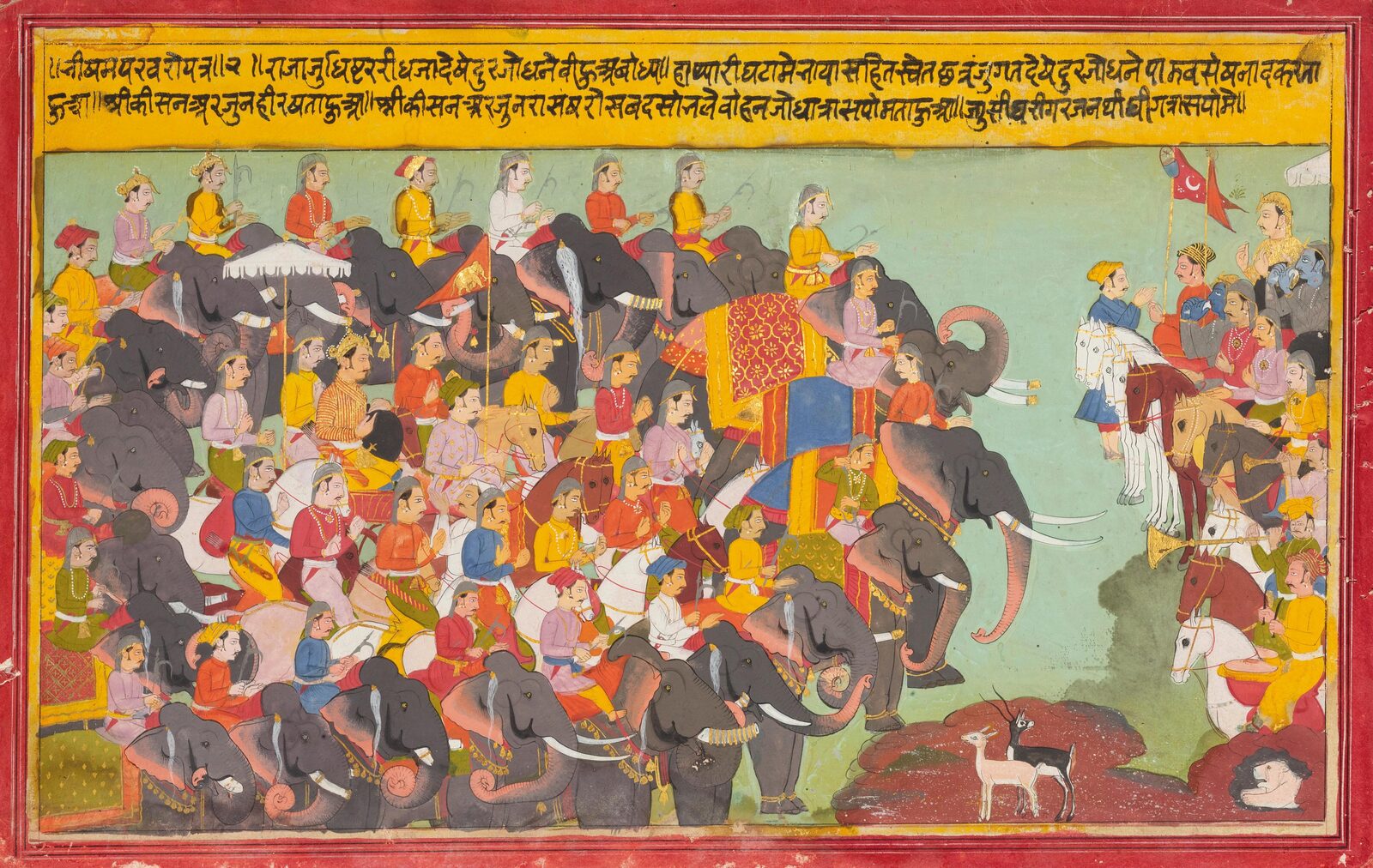
The battle starts with a sequence of sound. First, Bhishma roars like a lion and sounds his conch and “then conches and drums and cymbals and horns”, causing “a loud uproar” (Bhishma Parva, Sec. XXV).[iii] Braatz and Dias (2021) interpret this passage as marking the start of battle and a contact with the sacred prior to actual fighting.[iv] In the context of communicative act, this sound signals to both armies that the battle has begun in the proper form. It announces intention and legitimizes the fight: it does not give an instruction.
The Conches of the Pandavas
The epic gives the names of the instruments. In the passage in Sec. XXV, the Pandava chiefs blow Panchajanya (of Krishna), Devadatta (of Arjuna), Paundra (of Bhima), Anantavijaya (of Yudhishthira), and Sughosha and Manipushpaka (of Nakula and Sahadeva).[v] Commenting on P. Lal’s transcreation of the epic, Bhattacharya (2017) observes that this is the only time when all Pandava conches are mentioned.[vi]
The names have meanings. According to Braatz and Dias (2021), following Hornell (1915) and Fonseca (2009, p. 30), Panchajanya refers to the name of a sea-demon, who was killed by Krishna and whose shell he used. Similarly, Paundra refers to a demon that was slain, and to the pundra forehead mark. Devadatta is interpreted as God-given, alluding to the discipleship of Arjuna to Drona.[vii]
Therefore, a strategic inference can be made that the name works as a brand. A person receives a sound, a name, history, and reputation so that the listener knows who is here and what warrior the person is. The example of the text shows naming and symbolic association only. There is no evidence that any particular conch possessed a definite tactical meaning.
Conches and the Projection of Martial Power
The epic is consistent regarding sound as intimidation. According to Ganguli’s translation, the Pandavas’ conches’ sound tore Dhritarashtra’s heart (Sec. XXV).[viii] Braatz and Dias (2021) mention the example of Bhima’s conch’s sound making Kalinga soldiers shake.[ix] Such sounds demonstrate the scale of an army that is ready to attack. The authors relate it to the Greek salpinx used as a medium of communication.[x] The impact takes place before any contact: the enemy hears numbers, courage, and resolution.
Sound on the Ancient Battlefield
Sound can also influence the audience inwardly. In Sec. XXV, Bhishma’s roar follows the assessment of the armies’ state performed by Duryodhana. The text says that it brought him great joy.[xi] Thus, sound provides the answer to a commander’s concern. Turning emotional points are also announced by sounds. For instance, at Bhishma’s fall, according to Braatz and Dias (2021), the sorrow is opposed to the conches’ sound of victory.[xii]
Standards serve as a means of reinforcing morale. Karna’s elephant-rope standard fills Karna’s troops with courage while inspiring fear among the enemy.[xiii] Hence, the fall of the standard serves as a communicative event.
Sound Beyond the Line of Sight
The clearest example of the link between sound and command is presented in the Drona Parva. Yudhishthira cannot find Arjuna and cannot hear Gandiva bow. He hears Panchajanya and is scared for his companion’s life.[xiv] Then, he asks Bhima to “send me a message” via roaring in order to know whether Arjuna, Krishna and Satyaki are all right. Bhima’s roar drowns all the sounds and is heard by everyone.[xv]
It provides situational awareness. A general who is unable to see his comrades experiences the battle by hearing it and gets a response through sound. The interaction is impromptu between brothers and not a signal, in agreement with the main message of the article.
Sound and sight
Visual signals are provided by standards. Bhishma’s features a palm tree with five stars, Drona’s a golden altar with a water-pot and a bow, and Duryodhana’s a jeweled elephant.[xvi] The standard is silent, permanent and visible from afar. Sound is temporary but penetrates obstacles and does not need a line of sight. The epic does not portray them as a planned system. But together they offer each general a dual signature, one visual and the other acoustic. This duality is the interpretation of the author.
Historical inference
The description of sound in the epic conforms to a broader tendency. Chakravarti’s research on ancient Indian warfare includes “war music”[xvii] among the functions of the battle ground, along with inspiring the soldiers. Braatz and Dias (2021), citing Chakravarti (p. 99, edition-dependent), quote Bāṇa’s Harshacarita (seventh century CE), where drumbeats indicate a march.[xviii] This is a later example and cannot be retroactively attributed to the epic.
The most prudent conclusion would be that sound in early Indian warfare conveyed course, mass messages (assembly, advance, alarm, celebration), along with inspiration and intimidation. The passages in the epic analyzed above reveal no code assigning specific meanings to specific blasts.
Conclusion
In the Mahabharata, sound fulfills four strategic roles, it declares intentions, provides the generals with an acoustic identity, demonstrates power and ensures cohesion. Together with the standards, sound helped to make an army visible, audible and identifiable. The epic is a poetic collage and its historicity is disputed.[xix] It thus preserves the way sound was envisioned in war better than any communication system.
Notes
[i] Anuttama Banerji, “Strategic Communication,” National Maritime Foundation, December 30, 2025,
[ii] J. G. Braatz and C. K. B. Dias, “‘No clangor das conchas’: o som da guerra em Mahabharata,” Classica 34, no. 1 (2021): 187–204.
[iii] K. M. Ganguli, trans., The Mahabharata, Bhishma Parva, sec. XXV.
[iv] Braatz and Dias, “‘No clangor das conchas,’” 190–91.
[v] Ganguli, The Mahabharata, Bhishma Parva, sec. XXV.
[vi] Pradip Bhattacharya, “The Bhishma and Drona Parvas: The P. Lal Transcreation,” 2017.
[vii] Braatz and Dias, “‘No clangor das conchas,’” 193–94; John Hornell, The Indian Conch (Turbinella pyrum) and Its Relationship with Hinduism (London: Williams & Norgate, 1915); Carlos Alberto Fonseca, Canção do venerável: Bhagavad Gita (Rio de Janeiro: Globo, 2009), 30.
[viii] Ganguli, The Mahabharata, Bhishma Parva, sec. XXV.
[ix] Braatz and Dias, “‘No clangor das conchas,’” 194–95.
[x] F. V. Cerqueira, “Melodia sangrenta: a trombeta e a guerra na Grécia Antiga,” Anos 90 25, no. 47 (2018): 149–88; cited in Braatz and Dias, “‘No clangor das conchas,’” 195
[xi] Ganguli, The Mahabharata, Bhishma Parva, sec. XXV.
[xii] Braatz and Dias, “‘No clangor das conchas,’” 198–99.
[xiii] Ganguli, The Mahabharata, Karna Parva, sec. XCI.
[xiv] Ganguli, The Mahabharata, Drona Parva, sec. CXXV.
[xv] Ganguli, The Mahabharata, Drona Parva, sec. CXXVIII.
[xvi] Bhishma Parva, sec. XVII.
[xvii] P. C. Chakravarti, The Art of War in Ancient India (Dacca: University of Dacca, 1941), chap. XII.
[xviii] Braatz and Dias, “‘No clangor das conchas,’” 199–200.
[xix] B. B. Lal, “The Two Indian Epics and Archaeology,” Antiquity 55, no. 213 (1981): 27–34.