
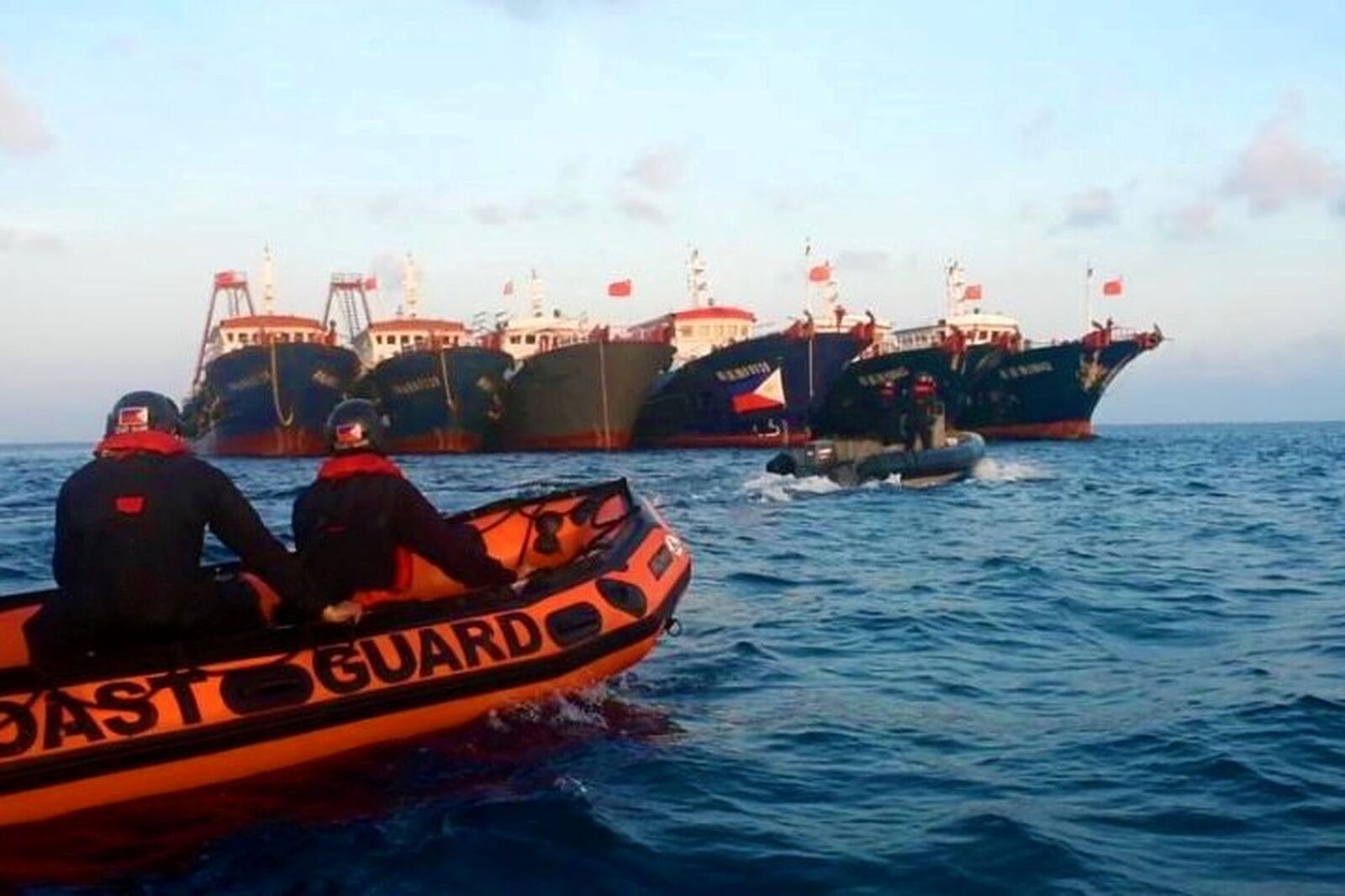
A struggle for islands, maritime borders, natural resources, and vital sea lanes is a common description of the South China Sea. Beneath the apparent rivalry between coast guard ships, navy units, and marine militias, however, is a struggle to influence attitudes and information. Determining what transpired, who was at fault, and whose actions were justified can be just as strategically significant as physical presence at sea in a setting where conflicts often stay below the threshold of armed conflict. As a result, information warfare has grown in importance in relation to the South China Sea issues.
The United Nations Convention on the Law of the Sea (UNCLOS), which creates maritime rights, including an Exclusive Economic Zone that extends up to 200 nautical miles from coastal baselines, frames the issues at the legal level.[1] The political information landscape was further complicated by the South China Sea Arbitration in 2016. China opposed the proceedings and the award, while the UNCLOS-established tribunal reviewed issues pertaining to maritime entitlements and the legitimacy of various Chinese actions.[2] As a result, the conflict today encompasses conflicting interpretations of history, international law, and legitimacy in addition to conflicting claims and activities at sea.
Information Warfare as a Strategic Instrument
Official government statements, state media narratives, social media campaigns, diplomatic messaging, selective evidence disclosure, psychological operations, and, increasingly, digitally enabled influence activities are all examples of information warfare in the South China Sea. Persuading every audience is not always its goal. Instead, it can aim to generate ambiguity, bolster internal support, undermine the legitimacy of an adversary, sway third countries, and develop a preferred narrative of events.
This is especially crucial in the "grey zone," which is the area between open armed combat and regular diplomatic competition. Carefully crafted narratives that present the actor as protective rather than hostile might accompany coast guard operations, maritime militia, and other coercive acts. The political costs of actions that may otherwise draw condemnation from around the world can therefore be decreased by the information dimension.
China and the Battle for the Narrative
The significance of strategic narratives is exemplified by China's official stance. Beijing claimed sovereignty over the South China Sea islands as well as related maritime rights and "historic rights," claiming that Chinese actions in the region are backed by a lengthy historical record.[3] China also contends that rather than using processes imposed by outside parties, issues should be settled through negotiation between directly involved states.
This narrative serves several purposes. At home, it links national renewal and sovereignty with the South China Sea. Instead of trying to change the regional order, it portrays Chinese acts as defending established rights on a global scale. As a result, Chinese state media and diplomatic remarks are included in the larger struggle for legitimacy.
Physical activities can also be enhanced by information operations. China's maritime militia supports China's goals in contested waters, according to research by the Center for Strategic and International Studies.[4] When such actions are followed by conflicting reports of an encounter and diplomatic communications, observers are faced with the further difficulty of figuring out not just what happened but also which account is reliable.
Counter-Narratives and the Philippine Experience
A notable illustration of the use of information as a countermeasure is the Philippines. In the West Philippine Sea, Manila has progressively embraced what it refers to as a "transparency approach." Encounters with Chinese warships have been made public by Philippine officials, who have also made photographic and video evidence available and attempted to explain their interpretation of the events to both home and foreign audiences.[5]
The goal is to increase public awareness at home and foster support abroad. Transparency itself becomes a strategic tool in this sense, as the Philippine Information Agency has openly linked the effort to dispelling false information and raising public awareness of the maritime issue.[6]
The legal aspect is just as significant. Rather than letting individual maritime encounters be read only through conflicting national claims, the Philippines grounds its narrative in established international legal procedure by frequently citing the 2016 arbitral ruling. This shows that propaganda and information warfare are not always the same. Strategic tools can also include transparent communication, legal documentation, and reliable evidence.
Social Media, AI and the Emerging Information Environment
The speed and scope of this competition have changed due to the digitalization of information. Millions of people can watch a video captured during a maritime conflict before official remarks are made by countries. At the same time, altered film, deceptive subtitles, coordinated amplification, and fake narratives can confuse public comprehension.
An additional level of complexity is introduced by artificial intelligence. Deepfakes and synthetic media can create seemingly real remarks, pictures, or videos of political and military figures. False information spreading during a crisis could lead to public pressure for escalation before governments have confirmed the facts.
As a result, there is a strategic paradox: while technical advancements have increased the visibility of maritime activity, they have also made information more difficult to verify. Hence, states need to be mindful of both the maritime and information domains.
Why It Matters for India?
India's broader Indo-Pacific interests are related to the South China Sea. New Delhi has continuously backed freedom of navigation and overflight, respect for international law and UNCLOS, and peaceful conflict settlement. A rules-based regional order and ASEAN are also essential to India's Indo-Pacific strategy.[7]
Information resilience is becoming more and more important to Indian strategic planning due to India's growing maritime engagement with Southeast Asia, including the first ASEAN-India maritime exercise in the South China Sea in 2023.[8] As a result, India requires capabilities that go beyond conventional naval power. Stronger strategic communication, quick digital information verification, open-source intelligence capabilities, media literacy, and improved cooperation between defense, intelligence, and diplomatic organizations are some of these.
By encouraging information-sharing systems, maritime domain awareness, and evidence-based communication with ASEAN partners, India may also strengthen regional resilience. Making sure that strategic narratives are based on verifiable facts and international law should be the goal rather than controlling the media environment.
Conclusion
The South China Sea serves as an example of how contemporary strategic competition is fought not only with ships, planes, and missiles but also with stories, pictures, legal disputes, and internet platforms. Control over the information around the maritime domain and control over the actual maritime realm are becoming more intertwined.
Information can support China's sovereignty claims and give legitimacy to activity in the grey zone. Transparency and legal narratives can help the Philippines and other claimants mobilize international support and combat pressure. The lesson for India is very clear: information resilience is a critical component of maritime security in the Indo-Pacific.
Ultimately, the South China Sea is more than just a battle for control of certain waterways. Additionally, it is a struggle over who defines truth, builds credibility, and influences perceptions around the world. Long before a traditional fight starts, winning the narrative battle may have an impact on strategic outcomes in a time of hybrid and grey-zone rivalry.
References
- United Nations. “United Nations Convention on the Law of the Sea of 10 December 1982: Overview and Full Text.” United Nations, Division for Ocean Affairs and the Law of the Sea. Accessed October 7, 2026. https://www.un.org/depts/los/convention_agreements/convention_overview_convention.htm
- Permanent Court of Arbitration. “The South China Sea Arbitration (The Republic of the Philippines v. The People’s Republic of China), PCA Case No. 2013-19.” Permanent Court of Arbitration. Award, July 12, 2016. https://pca-cpa.org/ar/cases/7/
- Ministry of Foreign Affairs of the People’s Republic of China. “Statement of the Government of the People’s Republic of China on China’s Territorial Sovereignty and Maritime Rights and Interests in the South China Sea.” May 30, 2024. https://www.fmprc.gov.cn/eng/wjb/zzjg_663340/bianhaisi_eng_665278/plpbo/202405/t20240530_11324663.html
- Asia Maritime Transparency Initiative and Center for Advanced Defense Studies. “Pulling Back the Curtain on China’s Maritime Militia.” Center for Strategic and International Studies, November 18, 2021. https://www.csis.org/analysis/pulling-back-curtain-chinas-maritime-militia
- Gasingan, Debbie. “PH Continues to Implement ‘Transparency Strategy’ in WPS.” Philippine Information Agency, August 1, 2024. https://pia.gov.ph/news/ph-continues-to-implement-transparency-strategy-in-wps/
- Paunan, Jerome Carlo. “NTF-WPS Official Promotes West Philippine Sea Transparency.” Philippine Information Agency, September 20, 2024. https://pia.gov.ph/news/ntf-wps-official-promotes-west-philippine-sea-transparency/
- Ministry of External Affairs, Government of India. Annual Report 2024–2025. New Delhi: Ministry of External Affairs, 2025. https://www.mea.gov.in/annualreports?dtl/39677/Annual_Report_2024-2025
- Ministry of Defence, Government of India. “Sea Phase of ASEAN-India Maritime Exercise – 2023.” Press Information Bureau, May 9, 2023. https://www.pib.gov.in/PressReleasePage.aspx?PRID=1922815®=48&lang=2