

Introduction
The Indian Ocean has long been a space of communication as well as commerce. Monsoon winds carried ships, but also news, credit, languages, religious ideas and reputations between Africa, Arabia and South Asia.[1] This article argues that India’s links with East Africa should be read in that wider sense. Historically, they were uneven and shaped as much by East African coastal communities as by Indian merchants. Today, the Indian Navy uses ships, exercises and information centres to signal commitment and build trust. The two periods should not be equated: earlier exchange was dispersed and unplanned, whereas contemporary strategic communication is institutional and deliberate.
Historical Trade Networks
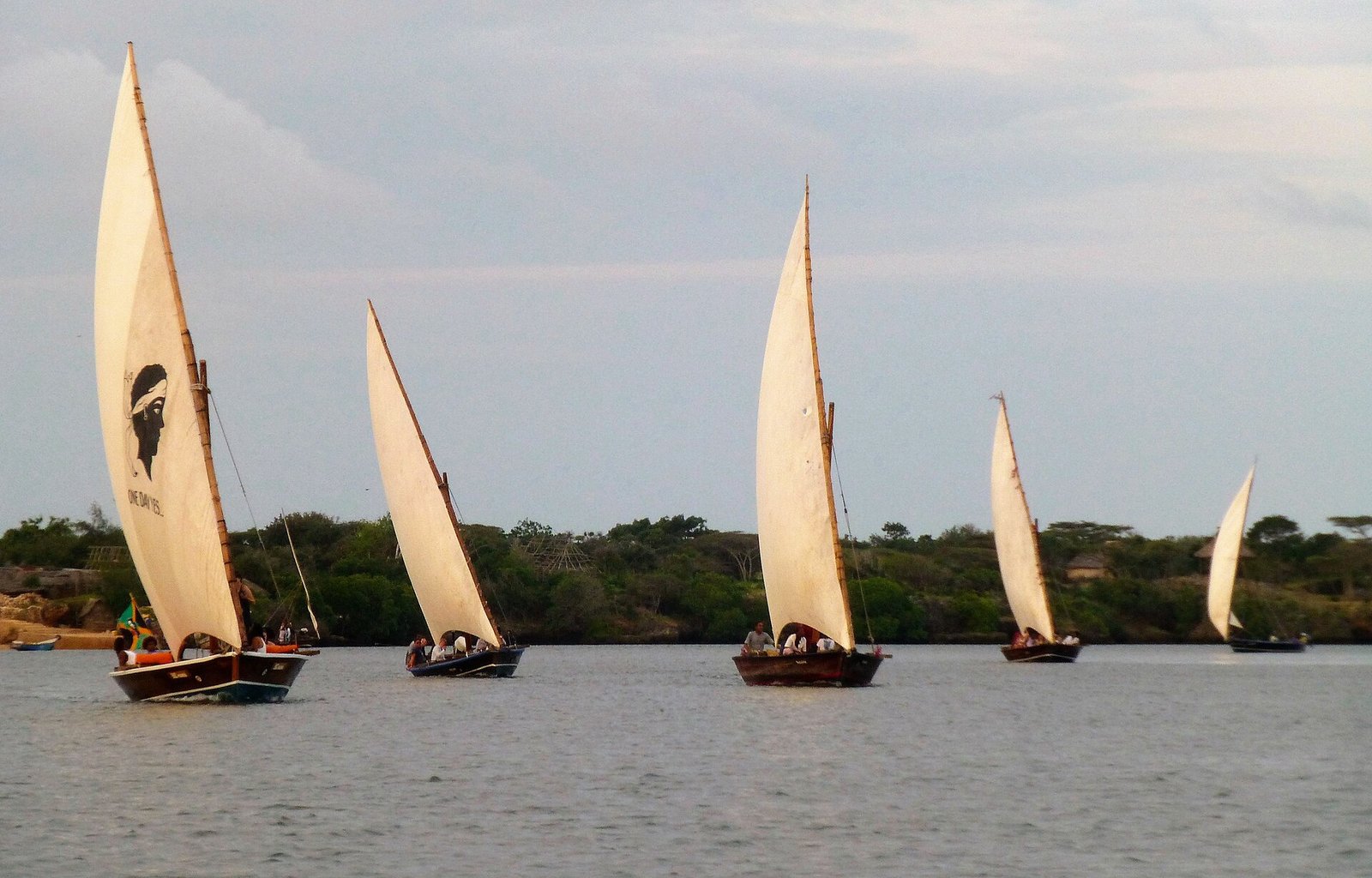
Indian goods reached the East African coast early, but the evidence needs care. Hawkes and Wynne-Jones find that coastal settlements were linked to Indian Ocean networks from the seventh century CE, yet goods from India before about 1000 CE are rare, which suggests that India–Africa trade was not yet economically significant.[2] Pollard and Kinyera’s study of seventh- to tenth-century imports finds African ivory, gold and enslaved people exchanged for beads, cloth and other goods from the Middle East, the Indian subcontinent and the Far East. Vessels from the Middle East and western India used the northern Swahili coast, from Lamu to Unguja (Zanzibar), where Swahili ports acted as transshipment points.[3] These were active intermediaries, not passive markets. By the time the Portuguese arrived, East African traders dealt directly with Aden or western Indian ports rather than the Persian Gulf.[4]
Gujarat was central to western India’s maritime exchange. Alpers and Goswami’s volume traces Gujarati trade over some 2,000 years with African, Arab, Southeast Asian, Chinese and European merchants,[5] including Indian textiles reaching central East Africa in the nineteenth century.[6] The monsoon made voyages seasonal. As an interpretation, not a documented finding, the pauses between sailings probably made ports places where prices, rulers and routes were discussed.
Cultural and Social Influence
Cultural exchange is harder to document than trade and is easily overstated. Swahili society grew from African roots on the coast, and its people actively shaped how their past was told. Horton judged large-scale Persian settlement unlikely, yet coastal peoples who claimed Shirazi origins called themselves “Shirazi”, and an “Afro-Shirazi” party was founded in 1957.[7] Swahili also absorbed Persian loanwords, mainly nautical terms.[8] Origin stories, like vocabulary, were chosen and adapted by coastal communities.
Evidence for Indian influence is thinner for the first millennium. Hawkes and Wynne-Jones discuss a bronze lion found at Shanga that may have been brought by an Indian merchant or traveller, or acquired by the local elite. They treat it as a hint of movements of people, styles, ideas and religions, not proof, and note Horton’s suggestion that artisan communities travelled between India and Africa.[9] Firmer evidence comes later: Goswami’s work on Kachchhi traders in Muscat and Zanzibar covers 1800–1880.[10] Ho and Sheriff’s volume frames such movement as interaction that shaped societies on both sides of the ocean.[11]
Contemporary Naval Networks and Strategic Communication
Contemporary engagement is institutional, and official statements are explicit about purpose.
AIKEYME was inaugurated on 13 April 2025 at Dar es Salaam. India and Tanzania co-hosted it, and Comoros, Djibouti, Kenya, Madagascar, Mauritius, Mozambique, Seychelles and South Africa participated.[12] Navy officials explained the name as “unity” in Sanskrit.[13] The accompanying IOS SAGAR deployment of 2025 took INS Sunayna to Dar es Salaam, Nacala, Port Louis, Port Victoria and Malé, with 44 personnel from nine partner nations aboard and joint exclusive economic zone surveillance with Mauritius.[14] The 2026 edition, with personnel from 16 countries, called only at South and Southeast Asian ports.[15] The format is thus a regional template, not an East African commitment alone.
The Information Fusion Centre–Indian Ocean Region (IFC-IOR), set up at Gurugram on 22 December 2018, works more quietly. It has hosted liaison officers from 12 countries, including Mauritius and Seychelles, and in February 2023 signed an agreement with Seychelles’ Regional Coordination Operations Centre on maritime domain awareness, information sharing and expertise development.[16] This connects India to the Indian Ocean Commission’s architecture, whose signatories include Comoros, Djibouti, Kenya, Madagascar, Mauritius and Seychelles. The Navy’s 2023 list of liaison officers, however, includes no mainland East African state.[17]
On anti-piracy, India reports deployments in the Gulf of Aden and off East Africa since 2008, with 3,440 ships and over 25,000 seafarers escorted,[18] and more than 21 ships deployed between December 2023 and March 2024.[19]
Together, these activities signal reliability: AIKEYME through symbolism and shared training, the IFC-IOR through routine data exchange, and patrols through presence. The sources, however, are Indian government statements. They show intent and activity, not partners’ assessments of trust.
Conclusion
India’s historical ties with East Africa were not Indian influence imposed on passive coasts. Coastal communities selected goods, claimed ancestries and acted as intermediaries, while Indian merchants, above all from Gujarat and Kachchh, took part in a system that others also shaped. In the sources reviewed, early Indian goods are modest and the best-documented merchant settlement is nineteenth-century.
Contemporary maritime diplomacy rests on a different logic. It is planned, funded and communicated by the state, and its message is reliability: ships that arrive, information that flows and partners who train together. History offers India familiarity with the western Indian Ocean as a shared space, and a reminder that durable connection has depended on reciprocity. These initiatives will be judged by whether East African partners see their own priorities, such as surveillance of their waters and action against illegal fishing, reflected in them. Measuring that response, rather than counting exercises, is the next task for researchers.
Notes
[1] Mark Horton, “East Africa i. Economic, Political, and Cultural Relations through 1900,” in Encyclopaedia Iranica, vol. 7, fasc. 6 (1996), https://www.iranicaonline.org/articles/east-africa-i-economic-political-and-cultural-relations-through-1900/; Abdul Sheriff and Engseng Ho, eds., The Indian Ocean: Oceanic Connections and the Creation of New Societies (London: Hurst, 2014).
[2] Jason D. Hawkes and Stephanie Wynne-Jones, “India in Africa: Trade Goods and Connections of the Late First Millennium,” Afriques 6 (2015), https://journals.openedition.org/afriques/1752.
[3] Edward Pollard and Okeny Charles Kinyera, “The Swahili Coast and the Indian Ocean Trade Patterns in the 7th–10th Centuries CE,” Journal of Southern African Studies 43, no. 5 (2017): 927–47, https://doi.org/10.1080/03057070.2017.1345266.
[4] Horton, “East Africa i.”
[5] Edward A. Alpers and Chhaya Goswami, eds., Transregional Trade and Traders: Situating Gujarat in the Indian Ocean from Early Times to 1900 (New Delhi: Oxford University Press, 2019).
[6] Sarah Fee, “Filling Hearts with Joy: Handcrafted ‘Indian Textiles’ Exports to Central Eastern Africa in the Nineteenth Century,” chap. 7 in Alpers and Goswami, Transregional Trade and Traders.
[7] Horton, “East Africa i.”
[8] Horton, “East Africa i.”
[9] Hawkes and Wynne-Jones, “India in Africa.”
[10] Chhaya Goswami, The Call of the Sea: Kachchhi Traders in Muscat and Zanzibar, c. 1800–1880 (Orient Blackswan, 2011).
[11] Sheriff and Ho, The Indian Ocean.
[12] Government of India, Press Information Bureau (PIB), Ministry of Defence, “Harbour Phase of Indian Navy’s Maiden Initiative ‘Africa-India Key Maritime Engagement Exercise’ Inaugurated … at Dar es Salaam,” press release, April 13, 2025.
[13] “India to Carry Out Mega Naval Exercise with African Nations Next Month,” Business Standard, March 24, 2025, https://www.business-standard.com/external-affairs-defence-security/news/india-to-carry-out-mega-naval-exercise-with-african-nations-next-month-125032400914_1.html.
[14] PIB, Ministry of Defence, “PR-Event Brief INS Sunayna – Mission IOS SAGAR,” press release, April 5, 2025 (PRID 2119169); PIB, Ministry of Defence, “IOS SAGAR in Port Louis, Mauritius,” press release, April 27, 2025 (PRID 2124711); PIB, Ministry of Defence, “IOS SAGAR in Port Victoria, Seychelles,” press release, May 2, 2025 (PRID 2126198); PIB, Ministry of Defence, “INS Sunayna (IOS SAGAR) Returns to Kochi on Successful Completion of Month Long Deployment,” press release, May 8, 2025.
[15] PIB, Ministry of Defence, press release on the flag-off of IOS SAGAR from Mumbai, April 2, 2026; PIB, Ministry of Defence, “IOS SAGAR Ship Arrives at Phuket, Thailand,” press release, April 15, 2026.
[16] Indian Navy, “Maritime Security: Memorandum of Understanding (MoU) between The Information Fusion Centre – Indian Ocean Region (IFC-IOR) and Regional Coordination Operations Centre (RCOC),” https://indiannavy.nic.in/node/35588.
[17] Indian Navy, “Maritime Security: Memorandum of Understanding (MoU).”
[18] PIB, Ministry of Defence, “Maritime Security,” press release, February 2, 2024.
[19] PIB, Ministry of Defence, press release on Indian Navy maritime security operations, March 23, 2024.