
“If you are getting something for free, someone is probably getting something from you.”
The metaphorical premise of these exact words actually embeds the core conflict of the digital age! As we step into each new day, the availability, shareability, and consumption of information have expanded through social media, search engines, and other digital services to a scale greater than ever before. However, such an exchange does not take place without value, with attention, behaviour, and engagement becoming valuable assets of the digital economy.
As Matteo Cinelli et al. note in their Proceedings of the National Academy of Sciences study on social media, digital platforms have fundamentally altered the way people access information and how information spreads, with algorithms and user interactions influencing the content people encounter.¹ The key question, therefore, remains: how do we use this structure to strike the right chord with the human mind, sustain interest in content, and keep information on screen?
From Engagement to Information Mapping
Classic methods of communication measurement tend to focus on familiar performance metrics such as reach, impressions, likes, comments, and shares. These indicators are important, but they primarily tell us how much attention a piece of content has received, not necessarily how much influence it has had on the conversation. A profile with a large number of followers, for instance, can generate significant reach without having much impact on how a discussion develops. At the same time, a profile with a relatively small following can play a far more important role by connecting journalists, experts, creators, and different communities, allowing a single story to move across multiple channels and reach audiences that may otherwise remain disconnected.
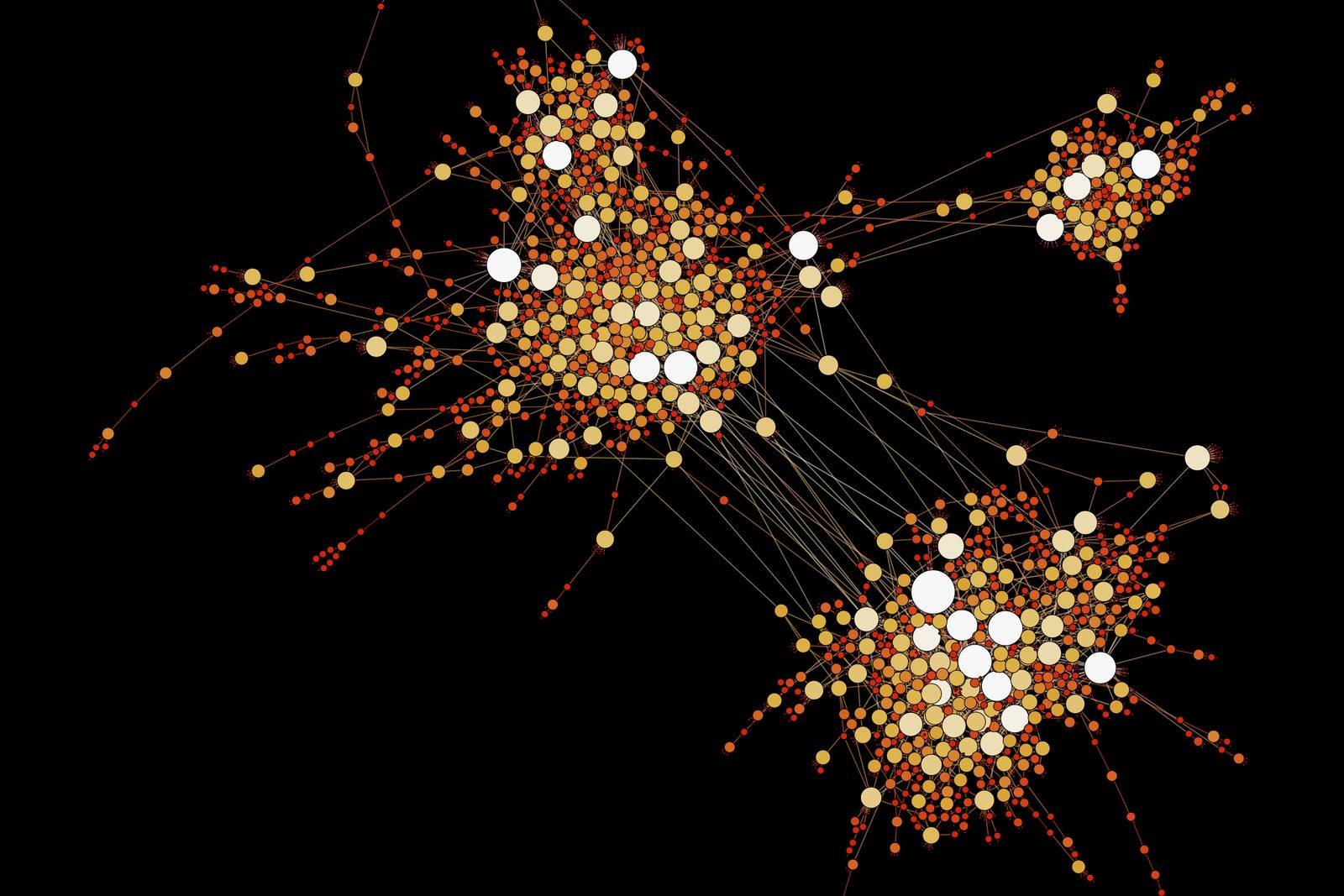
This is where data analytics becomes more than a tool for putting together performance reports. Network analysis allows people, organisations, media outlets, and communities to be mapped as nodes, while their interactions form the connections between them. Once these relationships are mapped, patterns begin to emerge. We can see clusters of closely connected communities, identify the actors who bridge otherwise separate groups, and trace how information moves between them. These are patterns that a conventional engagement report, despite showing the number of likes, shares, or views, would rarely capture.
Finding the Actors Who Matter
While data allows us to systematically analyse the role played by different participants, centrality measures help us locate actors occupying key structural positions within a network. Community detection helps identify clusters of users or groups that interact with one another more frequently, while diffusion analysis allows us to trace how a particular piece of information moves from its point of origin through different layers of users.
The Reuters Institute’s Digital News Report 2026 highlights this changing information environment, noting that social media and video networks have become the most widely used route to online news across the 48 markets covered by the study. According to the report, 54 percent of respondents used these platforms for news, compared with 51 percent who accessed news through the websites and apps of news organisations.²
How Narratives Travel
Narratives rarely remain limited to their source. A news story could become a social media update, which subsequently becomes a video. That video could enter a messaging group, attract commentary from a creator, and eventually find its way back into traditional media by becoming part of a wider public discussion.
This approach becomes particularly important when examining misinformation and information manipulation. A major study published in Science analysed approximately 126,000 news stories that circulated on Twitter between 2006 and 2017. The study found that false news travelled farther, faster, deeper, and more widely than true news within its dataset, with the effect particularly pronounced for false political news.³
The finding points to an important aspect of information flows: the reach of a narrative does not necessarily depend on the authority of its source. It can depend on how quickly it moves between networks, who amplifies it, and how many otherwise separate audiences it manages to connect.
The Platform Effect
There is, however, another aspect that complicates the picture. The data available to a researcher is not necessarily the same as the information environment experienced by a user. As noted in the 2025 Proceedings of the National Academy of Sciences paper on the changing information ecosystem for science communication, researchers often work with only a portion of the data generated by digital platforms.⁴ At the same time, algorithmic curation, recommendations, social endorsement, and platform-level experiments can influence what users actually encounter.
Therefore, information mapping needs to be approached with methodological precision. A network generated from public interaction data represents only the visible part of a much larger information environment. Private messaging, personalised recommendations, and audiences that remain invisible to researchers can all fall beyond the scope of analysis. The objective, therefore, should not be to produce an apparently exact but potentially misleading measure of who “controls” a conversation. It should be to develop the most defensible picture possible of how information moves within a particular information environment.
From Mapping to Strategic Communication
A mature information-intelligence system brings together several forms of analysis. Network analysis helps identify influential nodes, communities, and bridges. Content analysis identifies recurring narratives, themes, and frames. Temporal analysis examines when a conversation emerges and how quickly it develops. Diffusion analysis traces the movement of information from one community or platform to another, while audience analysis helps distinguish the different groups participating in the same discourse.
This approach also fits within the information-integrity framework outlined by the OECD, which emphasises the importance of understanding information flows and improving access to data for research on information manipulation while protecting privacy and freedom of expression. ⁵
However, the ultimate objective should not be surveillance for its own sake. Better mapping should lead to better communication: better information, more meaningful interaction, quicker identification of emerging issues, and more informed decision-making.
The New Question of Influence
The present-day information environment has made communication increasingly non-linear. Audiences are no longer passive recipients of messages. They interact with one another through networks of constant interpretation, amplification, and reconfiguration of information flows. Therefore, the age-old question of whose message reaches the largest audience has become less sufficient on its own. The more important question is: whose messages connect audiences, stories, and networks through which information spreads?
Data can hardly provide the whole truth. It cannot account for every interaction that occurs offline, nor can it determine intent from patterns alone. Yet, when network structure, message content, timing, and behaviour are considered together, analytics can reveal something that standard engagement metrics often fail to capture: the structure of the public conversation.
What follows is perhaps the more important question: understanding the structure of the conversation, its connections, and the direction in which it moves. That is where information intelligence begins.
Endnotes
- Matteo Cinelli et al., “The Echo Chamber Effect on Social Media,” Proceedings of the National Academy of Sciences 118, no. 9 (2021), https://doi.org/10.1073/pnas.2023301118.
- Nic Newman et al., Digital News Report 2026 (Oxford: Reuters Institute for the Study of Journalism, University of Oxford, 2026), https://reutersinstitute.politics.ox.ac.uk/digital-news-report/2026.
- Soroush Vosoughi, Deb Roy, and Sinan Aral, “The Spread of True and False News Online,” Science 359, no. 6380 (2018): 1146–1151, https://doi.org/10.1126/science.aap9559.
- “Our Changing Information Ecosystem for Science and Why It Matters for Effective Science Communication,” Proceedings of the National Academy of Sciences (2025), https://doi.org/10.1073/pnas.2400928121.
- OECD, Facts Not Fakes: Tackling Disinformation, Strengthening Information Integrity (Paris: OECD Publishing, 2024), https://doi.org/10.1787/d909ff7a-en; OECD, “Recommendation of the Council on Information Integrity,” OECD/LEGAL/0505, adopted 17 December 2024.