

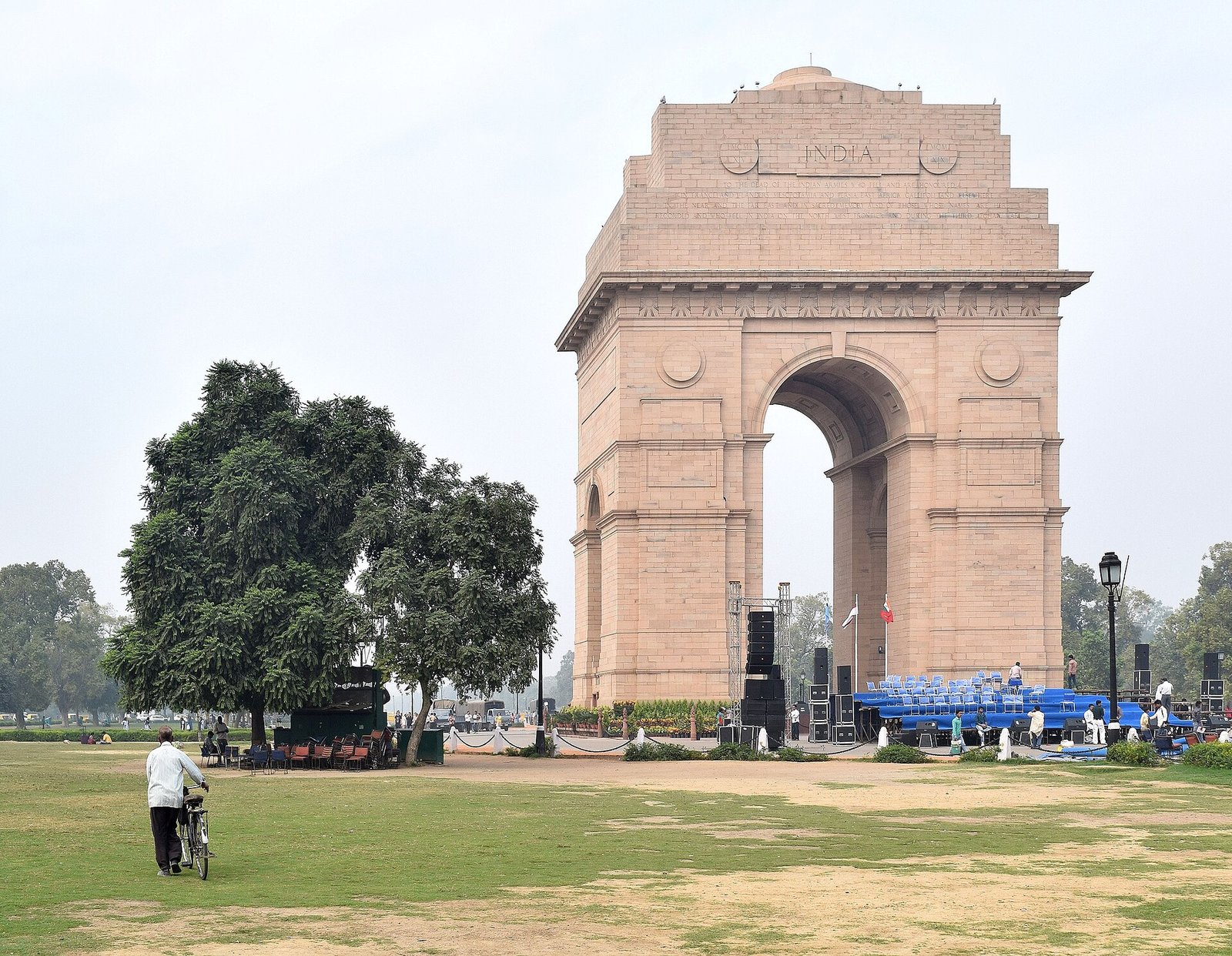
A battle can take days and even years. A monument usually stands through centuries and its message is written many years after the end of the battle. What will be constructed, where, who will be mentioned on it and what ceremonies will take place in honor of it is decided by statesmen, thus informing the citizens, the military and future generations about the significance of the war and what it requires from people. This article will trace the development of a monument through the example of India Gate and the National War Memorial.
The India Gate was initially built as the All-India War Memorial created by Edwin Lutyens and unveiled by the Viceroy Lord Irwin on 12 February 1931. This monument honors those over 74,000 military men of India who fought and lost their lives in the First World War, frontier and the third Afghan War of 1919, although the names of only 13,516 people are inscribed on it.[1] According to David A. Johnson, who has researched the colonial and postcolonial history of this monument, it was dedicated to the bond between the British Empire and India, reinforced by the war experience.[2] In terms of our framework, the message was that Indian soldiers’ sacrifice was for the benefit of the common imperial cause. The audiences of this monument were Indian subjects and wider imperial society; the intended effect was their loyalty to the imperial system. Just naming only some of the dead proves the presence of selection here.
After 1947 the monument did not change physically but got a different meaning. It got a new name India Gate, and Johnson describes how the site of unwelcome colonial memory became the symbol of the rebirth of India, although he reminds us that this interpretation itself is highly debated. In 1972, the Amar Jawan Jyoti was placed under the monument to honor the dead heroes of the 1971 war. As Neelima Jeychandran writes, in spite of being dedicated to the victims of the First World War, the India Gate came to symbolize the sacrifices of all Indian soldiers who died in the battles of modern India. The works of Partha Mitter demonstrate how Indian artistic forms were involved in rival political narratives time after time.[3] This monument can also be considered in this context. From my perspective, the structure remained the same while the message, audience and effect were rewritten. Thus, the renaming of the monument, new ceremonies and a new narrative changed the imperial monument into the proof of national identity and the legitimacy of the independent country’s wars. It is possible to use a monument to create a new meaning without reconstructing it.
The National War Memorial is another example, as it has been constructed to send a particular message. The monument has been dedicated by the Prime Minister of India, Narendra Modi on 25 February 2019. It is situated on 40 acres of land near the India Gate, aligned with the Rajpath and Central Vista. According to the official layout, the memorial has four concentric circles called Amar Chakra (immortality), Veerta Chakra (bravery), Tyag Chakra (sacrifice) and Rakshak Chakra (protection). On the walls of the Tyag Chakra, there are the names of 25,942 soldiers who died after 1947 in the wars of 1947, 1962, 1965 and 1971, Sri Lanka operations, Kargil, UN peacekeeping and counter-insurgency. There is a covered gallery with six bronze murals depicting famous battles. In addition, in another area there are bronze busts of the recipients of the Param Vir Chakra.[4]
According to the Ministry of Defence, this monument is the expression of the gratefulness of a nation to the armed forces and it strengthens sense of belonging, sacrifice and national pride of citizens. Even the planting is done according to this logic: the row of trees in the outer circle is a sign that reassures citizens of their safety, and each tree represents soldiers guarding the border 24 hours a day. All this is the statement of intention and it tells us what the state wanted to say, not how every visitor perceives it. In this respect, I analyze this monument using our framework. The events are the wars since 1947. The monument creates one narrative of duty and protection, leading the visitors to the center from protection through sacrifice and bravery to immortality. The messages are that service is honorable, the memory of death in service is eternal and security is provided by soldiers and citizens should be thankful for it. The audiences are citizens and schoolchildren, families of the deceased, serving personnel and foreign guests, as the ceremonial wreath laying by the representatives of nations and international community is organized here instead of India Gate. The possible effects are the confidence of the public in the armed forces, the common pride necessary for the creation of national identity and the knowledge about security being provided by individual sacrifice.[5]
However, like all monuments, the Indian ones are also selective and it is here that the potential strategic effects of the design can be easily overlooked. The very choice of what should be commemorated is a message, since an unrepresented memory is more unlikely to be preserved by the community. The National War Memorial begins in 1947 and therefore puts the focus on the wars of the independent state. India Gate memorialises the memory of colonial-era soldiers and only some of them get their names. Together, they partition the past into separate memories: an arch for the wars of the empire and a memorial for the nations. In 2022, the flame of the Amar Jawan Jyoti was joined to the flame of the National War Memorial, and then a statue of Subhas Chandra Bose was erected underneath the India Gate arch, replacing the former statue of George V.[6] My interpretation is that these moves shift the focus of the entire memorial complex from an imperial past to a national one and provide a single venue for the state’s version of its wars. Whether this is a correction to an historical oversight or simplification of a complex history remains a point of debate among historians and citizens.
For a defence audience, the take-home lesson from this case study would be that the messages of monuments continue to reverberate long after the first generation of their audiences has passed away. These messages depend on the control over the names, rituals and setting associated with the monuments. This case study demonstrates how the same monument can convey different messages to different audiences. Also, it provides an example of the state designing the message from the beginning. Both of the examined monuments celebrate the fallen but also shape the way the citizens commemorate war, view their military forces and understand security. It is in this capacity that the monuments can be considered to belong to the field of strategic communication. The caveat is that the analysis uses the strategic communication paradigm as its framework.
Notes
[1] National War Memorial, Government of India, “About Memorial,” accessed November 11, 2026, https://nationalwarmemorial.gov.in/about-memorial; “Tryst with History: 100 Years Since Duke of Connaught Laid Foundation Stone,” The New Indian Express, February 12, 2021.
[2] David A. Johnson, “New Delhi’s All-India War Memorial (India Gate): Death, Monumentality and the Lasting Legacy of Empire in India,” The Journal of Imperial and Commonwealth History 46, no. 2 (2018): 345–66.
[3] Neelima Jeychandran, “Representing and Reconstructing Memories of the World Wars in India,” RIHA Journal, no. 0170 (2017); Mitter, “Monuments and Memory for Our Times,” 159–67.
[4] National War Memorial, “About Memorial”; Ministry of Defence, Government of India, “Brief on National War Memorial,” January 2022.
[5] Ministry of Defence, “Brief on National War Memorial”; National War Memorial, “About Memorial.”
[6] Ministry of Defence, Government of India, “Flame Merging Ceremony at National War Memorial,” Press Information Bureau, January 21, 2022, https://www.pib.gov.in/Pressreleaseshare.aspx?PRID=1791535; Prime Minister’s Office, “PM Inaugurates Kartavya Path and Unveils the Statue of Netaji Subhas Chandra Bose at India Gate,” September 8, 2022.