

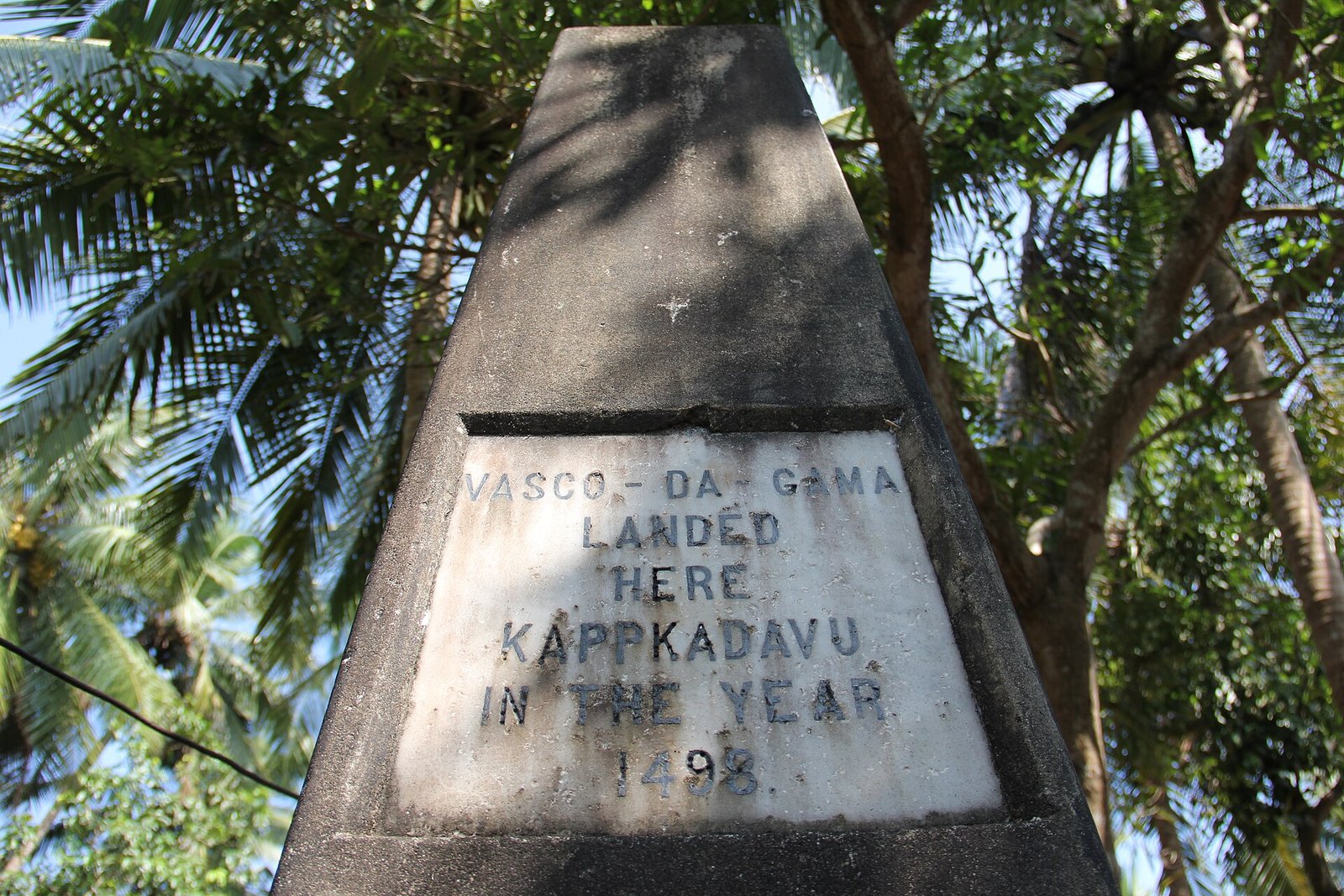
When Vasco da Gama reached Calicut in May 1498, the Indian Ocean was not an empty sea waiting for a new master. It was a busy commercial world in which Malabar pepper travelled west through Arab, Gujarati and Mappila merchants to the Red Sea and beyond. The Portuguese tried to replace this open system with one backed by fortresses, armed fleets and licences. The Zamorins of Calicut and the Kunjali Marakkars resisted, but not always together and not always for the same reasons. This article argues that their resistance can be read as a series of messages about who had the right to regulate the sea. Where those messages agreed, Portuguese authority was seriously tested. Where they clashed, the Portuguese gained.[1]
An Open Port and a Closed Sea
Calicut’s strength lay in openness. Duarte Barbosa, writing in the early sixteenth century, describes a port where Muslim merchants handled a large share of trade and where the ruler’s income depended on their ships.[2] The Zamorin’s authority rested less on controlling the sea than on offering safe harbour and predictable dues. Mappila shipowners linked Malabar to the Red Sea, Gujarat and the Coromandel coast.[3] Calicut’s message to the ocean was simple: come, trade, and be protected.
The Portuguese message was different. After the Portuguese factory at Calicut was attacked in December 1500, Cabral’s fleet bombarded the town, and the ruler of Cochin, a rival of the Zamorin, accepted Portuguese friendship.[4] The fort at Cochin, begun in 1503, gave them a permanent base, and Malekandathil shows how Cochin tied Portuguese shipping to local merchants and the Cape route.[5] For the Zamorin, each Portuguese gain at Cochin was also a signal that a rival was being armed against him.
The Cartaz as a Message
The cartaz system, which took shape in the early sixteenth century, required ships in the western Indian Ocean to carry a Portuguese pass or risk seizure. It was authority communicated on paper rather than by cannon. To accept a cartaz was to accept the Portuguese as a licensing authority at sea; to sail without one was a quiet refusal. The continued Portuguese effort to enforce it suggests that compliance was never complete, though this is an inference, and many merchants clearly adapted rather than resisted.[6]
Geography, Small Ships and the Fort at Chaliyam
Malabar’s coast of creeks, river mouths and shallow bars suited small, fast, oared vessels better than large Portuguese ships. Nambiar and Kurup and Mathew describe Marakkar crews using speed and local knowledge to harass Portuguese shipping.[7] Open battle was a different matter. At Diu in 1509 the Portuguese defeated an Egyptian and Gujarati fleet that Calicut’s rulers had supported, a reminder that guns and large ships dominated the open sea.[8] The Malabar answer was therefore a war of attrition close to shore.
The Marakkars, a Mappila seafaring family, served the Zamorin as naval commanders, and the title Kunjali became associated with them.[9] Their importance grew after 1531, when the Portuguese built a fort at Chaliyam, near the mouth of the Beypore river, close to Calicut. The fort threatened Calicut’s trade and its pride. When the Zamorin and Kunjali Marakkar III captured it in 1571, the act was a public answer: a Portuguese fortress on Calicut’s doorstep could be removed.[10]
Words and Faith: The Tuhfat al-Mujahidin
Resistance also had a voice. Zainuddin Makhdum of Ponnani wrote the Tuhfat al-Mujahidin around 1580, urging Muslims to fight the Portuguese and describing Portuguese conduct towards Malabar’s Muslim communities.[11] Its audience included the wider Muslim world, and its religious framing gave local resistance a larger meaning. Yet it should not be read as the whole story. The Zamorin was a Hindu ruler, and the long cooperation between his court and Muslim seafarers shows that trade, protection and political interest also bound them. Religion was one language of resistance, not the only one.
Kunjali Marakkar IV and the Breakdown of the Message
Kunjali Marakkar IV, Muhammad Ali, established a fortified base at Kottakkal near Vadakara, north of Calicut. Nambiar presents him as a commander who increasingly acted as an independent power at sea, and later tradition credits him with sovereign titles, though the extent of such claims is debated.[12] This created a problem. The Zamorin had long used the Marakkars to defend his coast, but a naval leader who appeared to claim sovereignty also challenged the Zamorin’s own position. By the late 1590s the Zamorin came to terms with the Portuguese and joined them against Kottakkal.[13] After a siege, Kunjali Marakkar surrendered to the Zamorin in March 1600, was handed to the Portuguese and was executed at Goa.
Let’s read as communication, the contest shows both strength and weakness. The Zamorins and Marakkars sent clear messages through action: the refusal to treat Portuguese licences as binding, the removal of the Chaliyam fort, and sustained raiding that raised the cost of Portuguese control. These actions told merchants, rival rulers and the Portuguese themselves that the coast was contested. But the messages came from two centres of authority, and when their aims diverged the Portuguese could exploit the gap. Panikkar and Kurup and Mathew write with sympathy for Malabar’s resistance, and a balanced reading must also note that Malabar’s rulers were divided and that Portuguese power, though costly to maintain, was never removed from the coast by Malabar’s own forces.[14]
Conclusion
The story offers a lasting lesson for maritime security. Naval strength alone did not decide the contest in Malabar. Control of ports, rules of passage, alliances ashore and a consistent political purpose mattered just as much. The Zamorins and Kunjali Marakkars showed that a smaller coastal power could raise the cost of domination through geography, local trade networks and credible action. They also showed that when naval commanders and political rulers send different signals, an outside power can turn division to its advantage.
Notes
[1] Pius Malekandathil, Portuguese Cochin and the Maritime Trade of India, 1500–1663 (New Delhi: Manohar, 2001); K. M. Panikkar, Malabar and the Portuguese (Bombay: D. B. Taraporevala Sons, 1929).
[2] Duarte Barbosa, A Description of the Coasts of East Africa and Malabar in the Beginning of the Sixteenth Century, trans. Henry E. J. Stanley (London: Hakluyt Society, 1866).
[3] Malekandathil, Portuguese Cochin; K. V. Krishna Ayyar, The Zamorins of Calicut: From the Earliest Times Down to A.D. 1806 (Calicut: Norman Printing Bureau, 1938).
[4] Krishna Ayyar, Zamorins of Calicut; Panikkar, Malabar and the Portuguese.
[5] Malekandathil, Portuguese Cochin.
[6] Malekandathil, Portuguese Cochin; Panikkar, Malabar and the Portuguese.
[7] O. K. Nambiar, The Kunjalis: Admirals of Calicut (Bombay: Asia Publishing House, 1963); K. K. N. Kurup and K. M. Mathew, Native Resistance Against the Portuguese: The Saga of Kunjali Marakkars (2000).
[8] Panikkar, Malabar and the Portuguese; Krishna Ayyar, Zamorins of Calicut.
[9] Nambiar, The Kunjalis; Krishna Ayyar, Zamorins of Calicut.
[10] Nambiar, The Kunjalis; Kurup and Mathew, Native Resistance; Krishna Ayyar, Zamorins of Calicut.
[11] Zainuddin Makhdum, Tuhfat al-Mujahidin, trans. S. Muhammad Husayn Nainar (Madras: University of Madras, 1942).
[12] Nambiar, The Kunjalis; Kurup and Mathew, Native Resistance.
[13] Krishna Ayyar, Zamorins of Calicut; Nambiar, The Kunjalis; Panikkar, Malabar and the Portuguese.
[14] Panikkar, Malabar and the Portuguese; Kurup and Mathew, Native Resistance; Malekandathil, Portuguese Cochin.